Get Full Government Meeting Transcripts, Videos, & Alerts Forever!
Get email alerts on the Finance Budget Reserves topic
No spam. Unsubscribe anytime.
HSS financial update: trust projection, budget instructions and reserves reviewed
Summary
CFO Pamela Levin presented a trust projection and year‑end estimates; Mayor’s two‑year budget instructions require roughly 5% cumulative reductions and the board heard AON’s actuarial review of IBNR and contingency reserves with a planned re‑calculation at 6/30/2018.
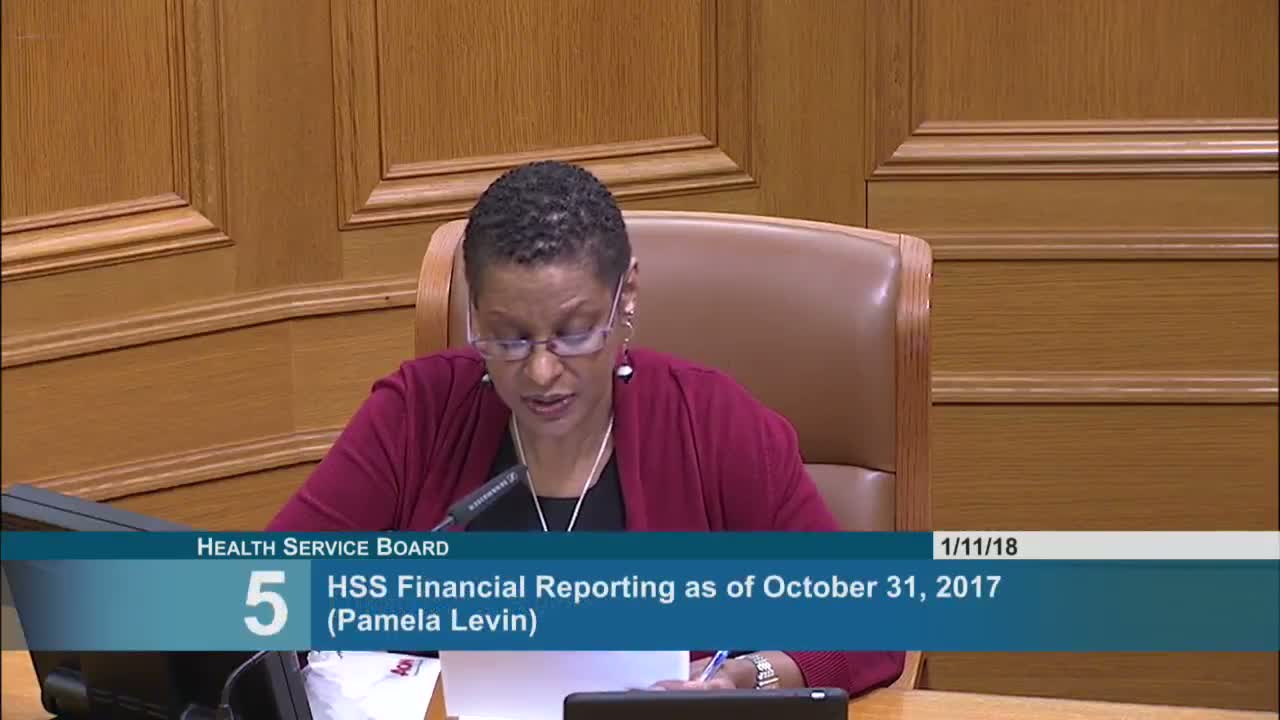
Pamela Levin, HSS chief financial officer, told the board that the Employee Benefit Trust Fund was projected at about $17.9 million as of June 30, 2018, an increase of roughly $3.6 million from the prior month’s figures, driven by mixed claims experience across plans and delayed rebates and pharmacy guarantees that typically arrive later in the fiscal year. Levin noted a $15,000 reimbursement under the adoption and surrogacy plan and said the amount of flexible‑spending account forfeitures will not be known until June.
Levin also summarized mayoral budget instructions for the two‑year 2018–19 and 2019–20 cycle: departments must propose ongoing reductions equal to 2.5% of general‑fund support in the first year and an additional 2.5% in the second (a cumulative ~5%), maintain current funded FTE counts, and align departmental proposals with citywide strategic priorities. Levin estimated the HSS value of the required reduction at roughly $84,000 in year one and an additional $84,000 in year two and told the board the department must submit its proposed budget to the Mayor by Feb. 21 and present it to the board on Feb. 8.
AON actuaries reviewed actuarial reserve items. Mike Clark explained the incurred but not reported (IBNR) reserve methodology and recommended IBNR levels as of 06/30/2017 for the UHC City Plan, Delta Dental and Blue Shield. Clark said the overall IBNR projection decreased by about $6.16 million largely because Medicare retiree programs changed to full funding on Jan. 1, 2017, reducing reserve needs for fully funded lines; he said all recommended reserves were fully funded and will be reset at 06/30/2018. Clark also recommended contingency reserves (about $5.5M for UHC, $3.1M for Delta Dental and $13.3M for Blue Shield, totaling just under $22M) and explained contingency funds differ from stabilization funds (contingency for catastrophic events; stabilization used to smooth premiums).
Board members asked for clearer slide wording (the board requested an amended slide be posted correcting a line implying a zero contingency figure for UHC) and for more detailed budget documentation and glossary notes during the upcoming budget cycle. Levin said staff will provide clearer footnotes and a bird’s‑eye glossary as the department prepares budget materials for February.