Get Full Government Meeting Transcripts, Videos, & Alerts Forever!
Get email alerts on the Uhc Mapd Addition topic
No spam. Unsubscribe anytime.
Board adds UnitedHealthcare national Medicare Advantage PPO to retiree options, asks staff to explore RFP next year
Summary
After questions about provider access, formulary exceptions and risk scoring, the Health Services Board voted to offer UnitedHealthcare's Medicare Advantage national PPO as an optional plan for Medicare retirees; the board added a friendly amendment to explore a competitive RFP process next year.
The Health Services Board voted to add UnitedHealthcare’s Medicare Advantage National PPO (MAPD) as an additional optional plan for Medicare A/B retirees, with final rates to be presented at the June retiree plan meeting and a board directive to study an RFP for similar plans next year.
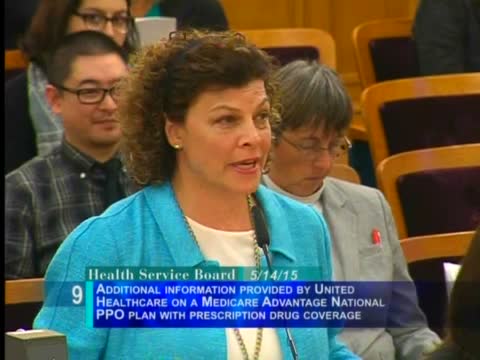
UnitedHealthcare account manager Jean Ferron Jones described the vendor’s annual formulary filing process and a list of identified "high‑risk" medications (based on the American Geriatrics Society). She said recent data re‑analysis showed 1,069 unique members were taking one or more drugs on that list, up from 905 in prior analyses, and explained the plan’s exception process and transition fills for members at their first January fill. "When you go to fill your first prescription in January, you will get a transition supply... Your next fill may not be covered, you need to talk to your doctor or you need to call UnitedHealthcare to determine what your next steps are," she said.
On provider access, UHC said most providers billing patterns work in the MAPD model: of about 50,514 providers used in the prior 12 months, 48,921 billed UnitedHealthcare. The vendor estimated only 27 providers had not billed them at all; UHC said members seeing those providers would pay up front and submit claims for reimbursement. "So those members, if they wanna use those providers, would pay upfront, would submit a bill to UnitedHealthcare, and we would reimburse them everything minus their copay," the vendor said.
Commissioners pressed on how many members would be affected if providers (for example some Sutter facilities) did not bill UHC directly. UHC said the issue affected a small percentage of total visits (roughly 3% of the 50,000 reported provider uses) and described outreach and education plans for members and providers if the MAPD option is adopted.
After public testimony — including retiree testimonials in favor of the option and comments urging careful education of members about provider availability — Commissioner Lehi moved to add the UHC MAPD option, with the condition that final rates be presented at the June retiree meeting. Commissioner Breslin sought a commitment to explore a future RFP for similar plan offerings; the board accepted a friendly amendment to review RFP options next year. The motion passed.
Board members said the MAPD option expands national provider access for retirees who travel or live outside the Bay Area, while cautioning that it is a different design and carries higher premiums in some comparisons. Staff and the vendor committed to robust member education sessions prior to open enrollment.