Get Full Government Meeting Transcripts, Videos, & Alerts Forever!
Get email alerts on the Healthcare Rates topic
No spam. Unsubscribe anytime.
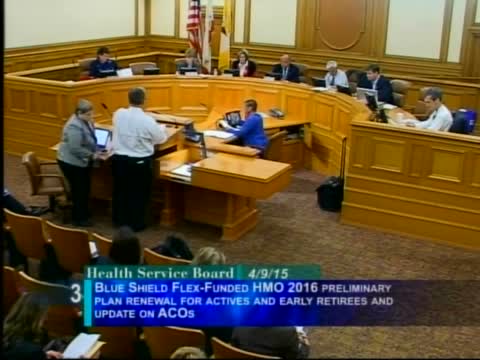
San Francisco HSS approves preliminary 2016 Blue Shield renewal after ACOs pledge tighter management
Summary
The Health Service System approved a preliminary 11.5% rate increase for the Blue Shield flex‑funded HMO for 2016 after Aon Hewitt recommended an 11.5% adjustment and ACO partners described programs to reduce admissions, emergency visits and specialty drug use.
The Health Service System Board voted to approve a preliminary 2016 renewal for the Blue Shield flex‑funded HMO program after hearing actuarial findings and provider presentations.
Anil Kosher, the Aon Hewitt actuary, told the board the core need was a 9.9% increase over 2015 rates; amortizing a prior excess cost (about $4.4 million under the board—s claim‑stabilization policy) raised the recommended increase to roughly 11.5%. Kosher illustrated the member impact in his packet: an individual medical/Rx premium would rise by about $5.16 monthly, a two‑party premium by about $10.33 and a family premium by about $35.48 under the recommended change.
Representatives of the plan—s accountable care organizations framed their accomplishments as the reason the program remains viable. Richard Fish, CEO of Brown & Toland Physicians, and Anne Marie Molyneux, Brown & Toland—s clinical director, described care‑management efforts — post‑discharge follow‑up, care coordinators, home‑visit teams and pharmacy management — they said have reduced admissions and emergency‑department utilization for the population they serve. Terry Hill of Hill Physicians described reduced facility utilization and investments in pharmacists and navigation staff to improve medication management and preventive care.
Board members pressed for periodic, measurable reporting. Commissioners asked for quarterly data on admission rates, ER visits, length of stay and pharmacy/specialty drug utilization so the board can track whether the promised savings materialize. Kosher and the ACO representatives agreed to provide periodic metrics and to return with more detail on the same.
Public speakers raised two persistent concerns: large, infrequent catastrophic claims that drive year‑to‑year volatility and the effect of formulary/pharmacy changes on retirees. The board directed staff to provide clearer, plan‑level cost impacts and to monitor how any formulary edits would affect high‑risk medication users.
The motion to approve the preliminary 2016 renewal for Blue Shield was moved, seconded and approved by voice vote. The approval is preliminary: staff and the actuary will return with final rate cards and more granular member‑impact data if any plan details change prior to a final adoption.
Next steps: staff will oversee more detailed metric reporting from ACO partners and provide plan‑level breakdowns of member impacts, and the actuary will include the updated numbers in forthcoming rate cards.