Get Full Government Meeting Transcripts, Videos, & Alerts Forever!
Get email alerts on the Aca Excise Tax topic
No spam. Unsubscribe anytime.
Board hears Aon Hewitt analysis showing potential $13M excise-tax exposure in 2018 without blending
Summary
Aon Hewitt presented a preliminary estimate that the Affordable Care Act's 2018 excise tax could generate roughly $13.1 million in liability for the system absent regulatory blending; blending pre-Medicare and Medicare retirees reduced that estimate to about $2.6 million in a modeled scenario.
Aon Hewitt actuaries told the Health Service Board that the Affordable Care Act's 2018 excise tax (the so-called "Cadillac tax") could expose the Health Service System to millions in tax liability if regulatory details are not favorable.
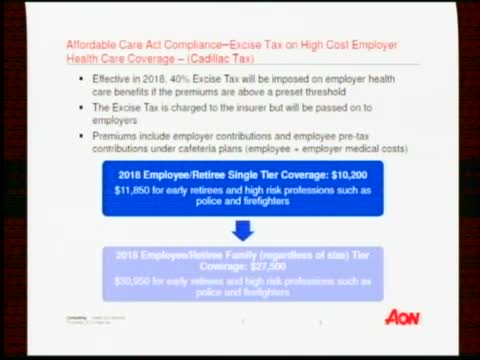
Tom Ricks of Aon Hewitt explained the basic rule: in 2018 employers will face a 40 percent excise tax on premiums above thresholds that Aon modeled at $10,200 for single coverage and $27,500 for family coverage (the law provides higher thresholds for pre-Medicare retirees and certain high-risk occupations). Ricks said the analysis considered both the legal scope of covered benefits (medical, self-funded dental and vision, and flexible-spending account contributions) and several trending scenarios.
Using the board's 2015 premiums trended to 2018 without blending retiree populations, Aon initially estimated an excise-tax liability of roughly $13.1 million in 2018, with about 87 percent of that burden coming from pre-Medicare retirees. Ricks and his team then ran a "good-faith" blending scenario that combined similarly situated pre-Medicare and Medicare retirees for the purpose of the excise calculation; that approach lowered the modeled 2018 liability to about $2.6 million.
Aon cautioned that final regulations and guidance had not been issued and that several model assumptions (trend rates, inclusion of FSA elections, and the approach to blending) materially affect the outcome. The firm noted that if Flexible Spending Account contributions are included at their maximum elections, active population costs and resulting tax exposure would increase (Aon's ceiling calculation added an estimated additional ~$670,000 in 2018 in an extreme scenario where every participant elected the $2,500 FSA maximum).
Several commissioners asked for methodological detail (trend rates and vendor-specific assumptions) and requested follow-up checks on any surprising per-member premium figures in the slide deck. Director Dodd and commissioners emphasized that local hospital rate trends (for example, Sutter-driven increases) would affect future excise-tax exposure and that earlier collective action to control hospital costs has direct implications for the 2018 liability.
Aon said it would work with HSS staff to explore liability-reduction opportunities and to refine estimates when federal regulations are issued.