Get Full Government Meeting Transcripts, Videos, & Alerts Forever!
Get email alerts on the Preservation Design Standards topic
No spam. Unsubscribe anytime.
Historic Preservation Commission urges Planning Commission to adopt objective preservation design standards
Summary
The San Francisco Historic Preservation Commission voted unanimously to recommend adoption of preservation design standards that add objective rules for additions and modifications to Category A historic buildings, aiming to preserve character while complying with state housing laws.
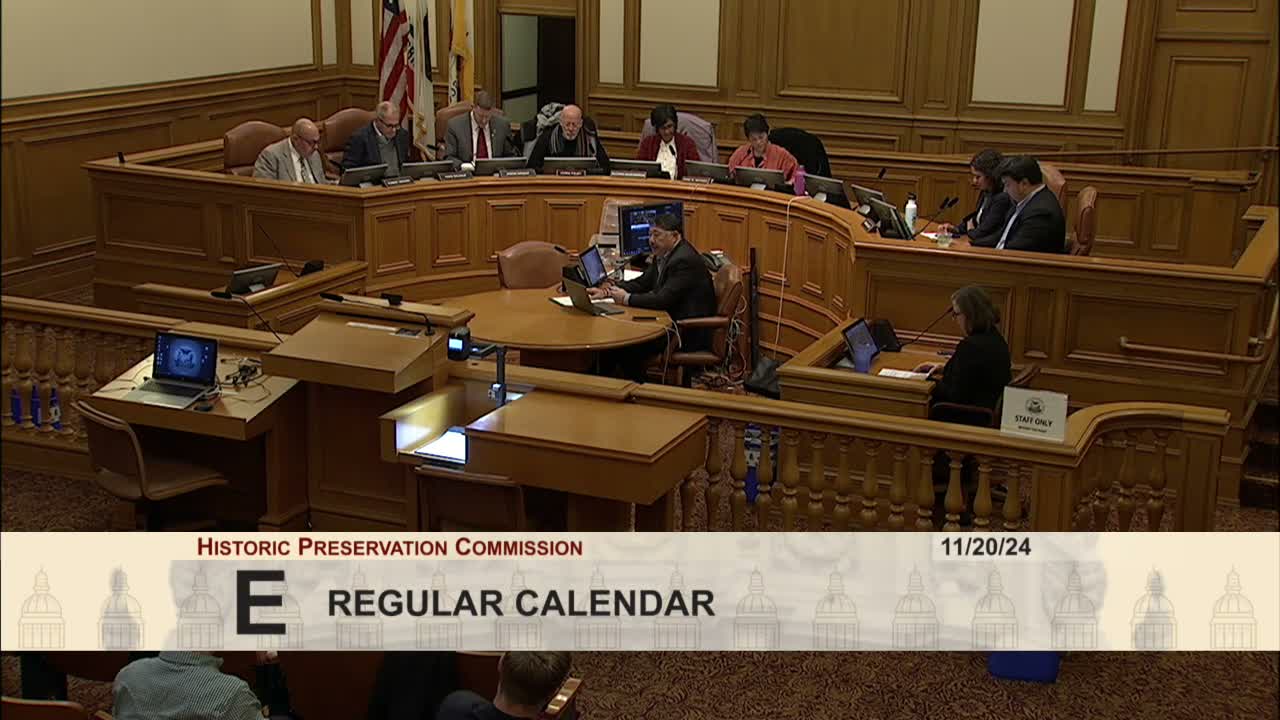
SAN FRANCISCO — The San Francisco Historic Preservation Commission on Nov. 20 voted unanimously to recommend that the Planning Commission adopt a new chapter of preservation design standards intended to provide objective rules for additions and alterations to already-identified historic buildings.
Staff said the standards are driven by state requirements — including the Housing Accountability Act and related legislation — that increasingly require objective, verifiable standards for projects that construct two or more housing units. "We do not currently have a set of adopted preservation design standards," planning staffer Rebecca Salgado said. "That means even an Article 10 individual landmark, you could make major modifications, remove a lot of historic fabric with no review from us." The staff proposal would apply the standards to Category A and A* properties, not to Category B or C properties for now.
The standards are organized around three chapters: regulatory context, existing features (treatment of character-defining features, windows, storefronts, entrances), and site design and architecture (massing, facade articulation, rooftop features, materials). They include several concrete rules, such as a 15-foot setback guideline for additions and a pragmatic window rule that uses a 1955 construction cutoff: replacement windows visible from the street on buildings built in 1955 or earlier should be wood; those built after 1955 may use aluminum, staff said. Rhianna Tong, planning staff, summarized the statewide context: California's Department of Housing and Community Development review and state bills "require ministerial review and approval for housing projects that meet a program's requirements and comply with all locally adopted objective standards."
Public commenters and commissioners urged changes or clarifications. Woody Labounty of San Francisco Heritage supported quick adoption with a commitment to frequent review: "Let's try to, like, actually have some reviews and updates to see how they go along." Neighborhoods United San Francisco representatives asked staff to return sooner with infill standards for noncontributing sites and cautioned about applying blanket rules to Category B properties. Commissioners probed technical details — why a 150-foot visibility radius was chosen, how the window matrix applies to different window types, and whether the standards could hinder housing production if broadened to include Category B properties.
Staff said most suggested edits could be incorporated without changing the standards' substance and that substantive changes would be returned to the HPC before Planning Commission adoption. The commission voted 6–0 to recommend adoption and requested that staff prepare the edits and a six-month check-in after the standards are implemented.
Next steps: staff will revise the draft to reflect the commission's technical comments and will present the item to the Planning Commission for formal adoption, currently targeted for the week of Dec. 5 or Dec.12, 2024.