Get Full Government Meeting Transcripts, Videos, & Alerts Forever!
Get email alerts on the Palace Hotel Signs topic
No spam. Unsubscribe anytime.
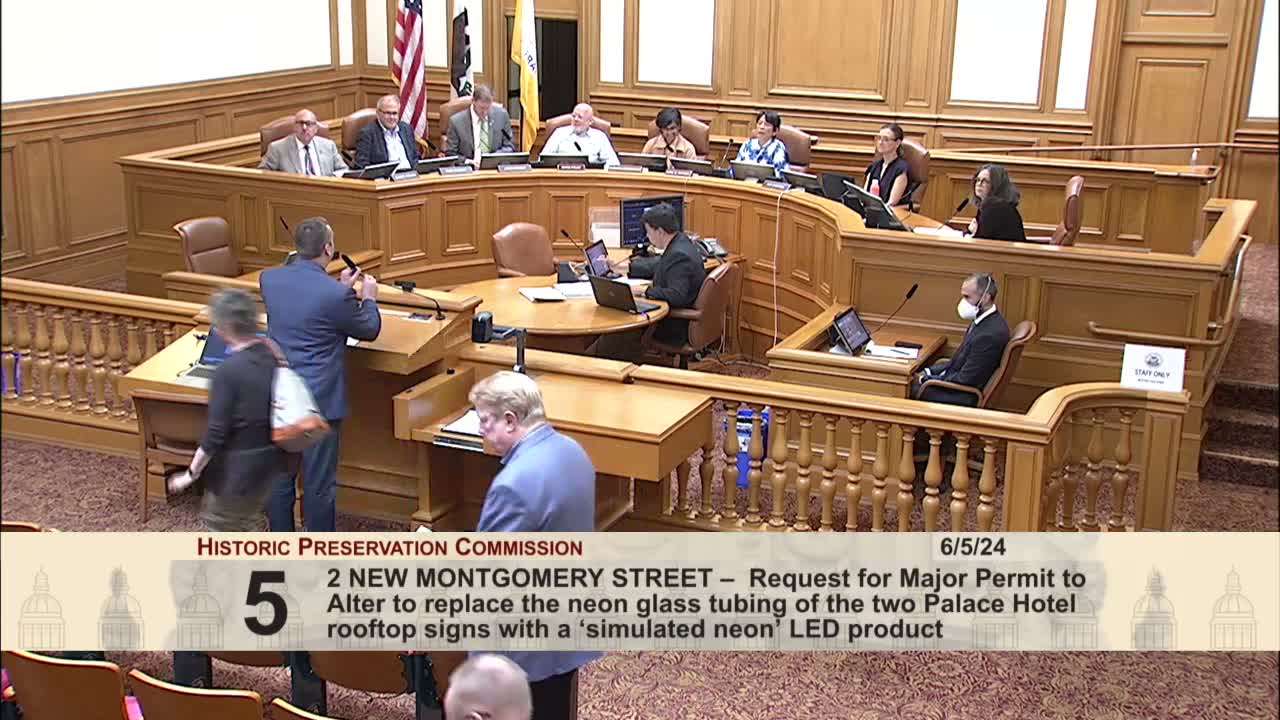
Historic Preservation Commission approves temporary LED for Palace Hotel signs with testing and a 7‑year review
Summary
After extensive public comment and technical debate, the commission approved a temporary LED rehabilitation of the Palace Hotel’s rooftop signs, requiring adhesive mock-ups, preservation of patterns, lumen/color measurements, an interpretive exhibit and a planned return to the commission in seven years.
The San Francisco Historic Preservation Commission on June 5 approved a conditional, temporary authorization for replacing the Palace Hotel’s rooftop porcelain neon letters with a simulated LED neon product, saying the conditions aim to balance preservation goals with the hotel’s financial realities.
Planning staff summarized the application as a request for a major permit to rehabilitate rooftop signage by replacing nonfunctional neon with a simulated LED product; staff said the proposal meets rehabilitation standards in the planning code and reported substantial public correspondence (roughly 270 letters urging restoration to neon and about 20 letters in support of the LED option).
James Tyler, the Palace Hotel’s director of engineering, presented operational and cost figures the sponsor submitted: a full neon retrofit for both rooftop signs was quoted at $297,788 with five-year maintenance estimated between $502,000 and $512,000; the LED alternative had an installation cost of $306,753 and five-year maintenance estimated at $205,000–$215,000. Tyler said the hotel is proposing LED now for financial feasibility and intends to preserve documentation and hardware so neon restoration could be possible later.
Speakers representing workers and neon advocates appeared at the podium. Mark Lisa of Teamsters Joint Council 7 urged approval of LED to support hotel jobs and recovery. Neon preservation advocates — including Bridal Ann Homan of San Francisco Neon — urged the commission to require testing to prove that the adhesive used to attach LED tracks would not damage the vintage porcelain letters, and to preserve patterns and documentation needed for future restoration. "If you vote for LED, you must include a test of that adhesive on vintage porcelain," Homan said.
Commissioners weighed preservation standards against the hotel’s economic condition and possible reversibility. Several commissioners said they preferred neon in principle but recognized the hotel’s near-term financial constraints. Concerns centered on materiality, the Secretary of the Interior standards for rehabilitation, and whether modern adhesives could be removed without harming porcelain enamel letters.
The commission ultimately approved the LED rehabilitation with a package of conditions that commissioners negotiated during deliberation: require a mock-up and lab test of the adhesive on vintage porcelain or equivalent samples to demonstrate removability; require the sponsor to archive and preserve neon patterns and documentation; direct staff to review the shop drawings and board mapping; require the hotel to return to the commission for a re-evaluation after seven years; include an interpretive exhibit or display relating to neon history (in coordination with Friends of Neon or similar) in the hotel; and measure lumens and color temperature at installation and at the end of the authorization period to document long-term changes.
Commissioners framed the move as a temporary, reversible authorization intended to restore the sign to visible, working condition now while preserving the option of future restoration to neon. The final motion passed 7–0.
Next steps: the project sponsor will submit adhesive test results, pattern preservation documentation, and shop drawings for staff review; the authorization will expire for review seven years from installation, when the commission will reconsider whether to require restoration to neon or permit continued LED use.