Get Full Government Meeting Transcripts, Videos, & Alerts Forever!
Get email alerts on the African American Context Statement topic
No spam. Unsubscribe anytime.
Commission reviews revised African American historic context statement; commissioners urge outreach and timely adoption
Summary
Planning staff presented a revised African American citywide historic context statement that expands histories, biographies and recommended landmarks. Public callers and commissioners urged broader inclusion (including Visitation Valley), more oral histories, and a timeline for adoption so the draft can be used in preservation decisions.
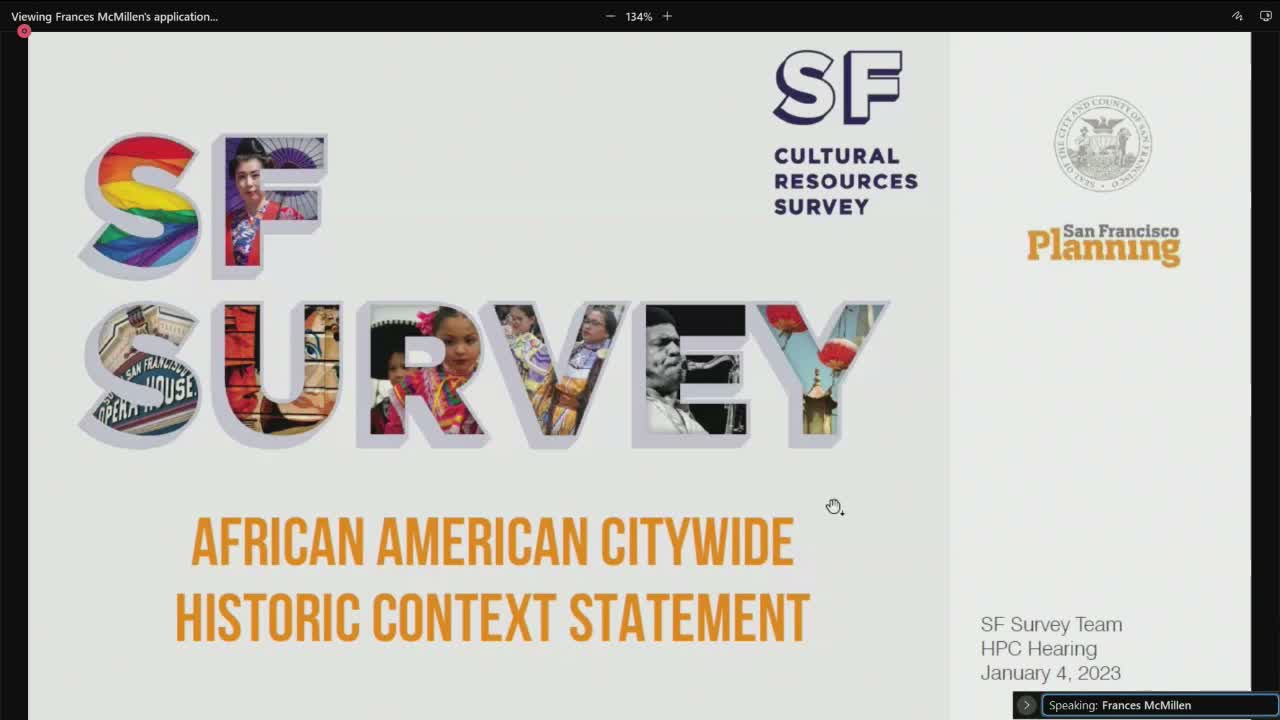
The Historic Preservation Commission received a presentation on Jan. 4 on a revised African American citywide historic context statement, and commissioners and callers urged staff to complete outreach and return the document for adoption.
Frances McMillan of the Planning Department summarized the draft’s history and revisions: the project began in 2013, a 2016 draft generated public comments and subsequent revisions were completed in 2019; focus groups in November and December 2022 informed recent edits. McMillan said the revised statement expands histories of churches and community institutions, adds biographies of African American professionals and artists, recognizes sites associated with the Black Panther Party, and addresses civil-rights history and anti-displacement efforts.
Several callers and commissioners praised the work but asked the department to expand geographic coverage and outreach. Russell Maureen, a Visitation Valley resident, told the commission the draft “covers the Fillmore great, but it doesn't cover Visitation Valley,” and urged that neighborhoods with strong African American histories not be left out. Other callers asked the Commission to prioritize adoption so the document can be used in evaluating preservation projects that are pending review.
Commissioners emphasized the statement should remain a living document but requested more oral histories, stronger emphasis on faith-based institutions and a clearer timeline for finishing edits. Commissioner Black asked about distribution to libraries and indexing; staff said the department shares these materials with the public library and state library. Commissioner Johns recommended outreach to long-time community figures, suggesting staff consult former Mayor Willie Brown.
Staff said they aim to finalize the statement within an aspirational one- to two-month window, contingent on continued community outreach and consensus. The presentation was informational; the Commission did not vote to adopt the statement at this meeting but provided detailed guidance for additional research and community engagement.