Get Full Government Meeting Transcripts, Videos, & Alerts Forever!
Get email alerts on the St Francis Wood Nomination topic
No spam. Unsubscribe anytime.
Commission backs St. Francis Wood National Register nomination, cites history and past deed restrictions
Summary
The Historic Preservation Commission unanimously recommended the St. Francis Wood residence park be forwarded to the State Historic Resources Commission for National Register consideration, noting architectural significance and historical deed restrictions tied to racial exclusion.
The San Francisco Historic Preservation Commission on April 6 voted unanimously to recommend a National Register of Historic Places nomination for the St. Francis Wood Historic District, forwarding comments and the commission’s resolution to the State Historic Resources Commission for the April 29 hearing in Sacramento. Commissioners and staff emphasized the district’s architecture, planned landscape features and also discussed past deed restrictions that excluded buyers of certain racial and ethnic backgrounds in the neighborhood’s early history.
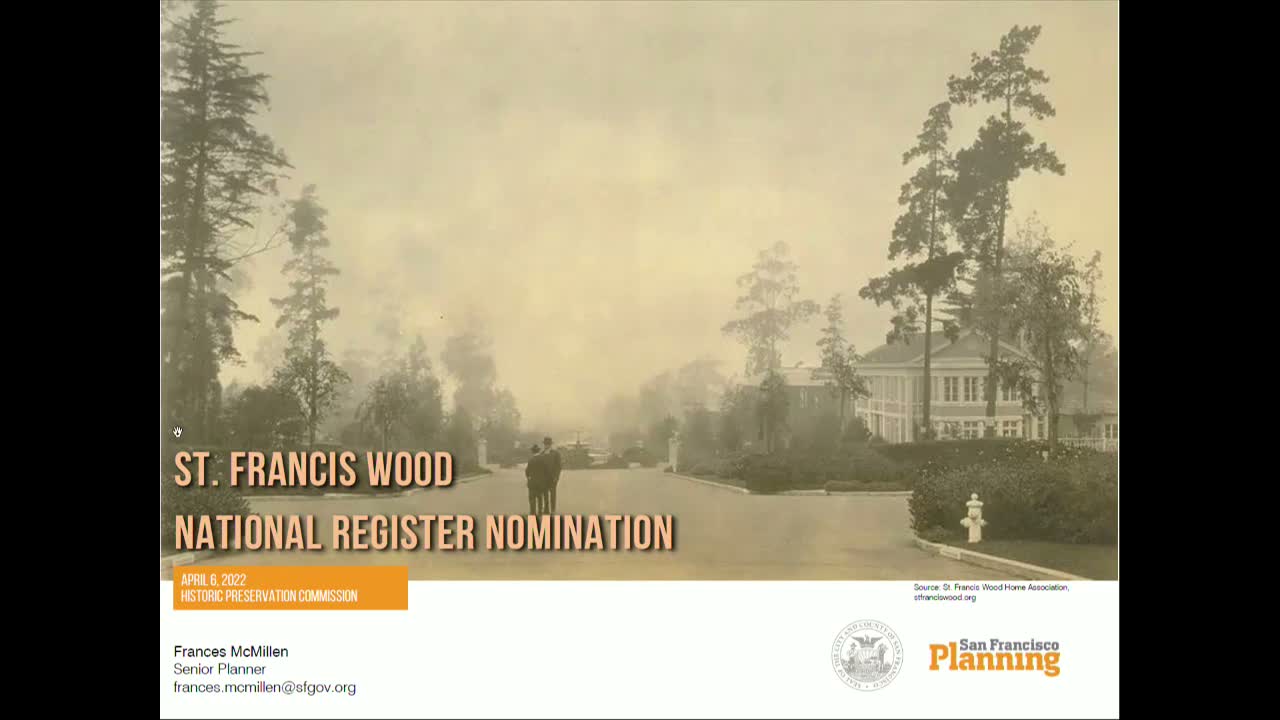
Planning staff (Francis McMillan) explained that St. Francis Wood, established in 1912 by Mason McDuffie, is a residence park characterized by curvilinear streets, entrance pillars and designed landscape features. The nomination lists a period of significance from 1912 to 1954, with contributing resources including scores of buildings and landscape structures and work by notable architects. Consultant Bridget Maley described the research and neighborhood outreach, saying the nomination drew on extensive archival material, an address/architect spreadsheet and community input including two public Zoom meetings in 2020.
Woody LaBounty of San Francisco Heritage told the commission the neighborhood “is a beautiful place” and urged support for the nomination. Commissioners commended the nomination’s thorough documentation but asked for clarifications in the nomination text — for instance, adding concrete as a material category and specifying street‑by‑street tree plantings where appropriate. Several commissioners explicitly recognized the neighborhood’s history of racially restrictive covenants; Commissioner Foley said the practice was “terrible” and urged the nomination to acknowledge the period’s discriminatory restrictions.
Commissioner Johns moved adoption of a resolution recommending the nomination (as presented and with staff‑noted minor corrections); the motion was seconded and passed 7–0. The commission’s resolution and any technical corrections will be forwarded to the Office of Historic Preservation and the State Historic Resources Commission for final review.
The commission record includes letters of support and objection: staff reported three objection letters and 16 letters of support had been received and provided to commissioners and the state reviewer.