Get Full Government Meeting Transcripts, Videos, & Alerts Forever!
Get email alerts on the Landmark Designation topic
No spam. Unsubscribe anytime.
Historic Preservation Commission recommends local landmark designation for Japanese YWCA at 1830 Sutter
Summary
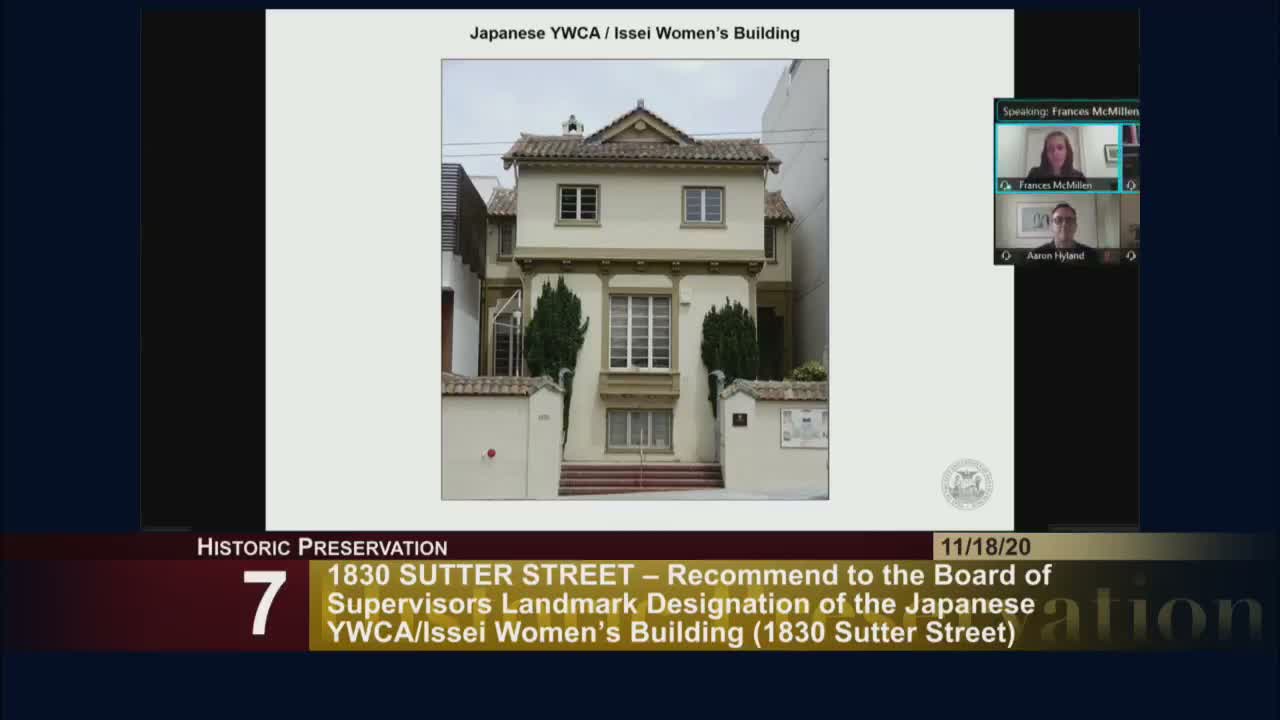
The San Francisco Historic Preservation Commission voted to recommend Article 10 landmark designation for the Japanese YWCA (Ise Women’s Building) at 1830 Sutter Street, citing its architectural significance by Julia Morgan and historical ties to Issei women, African American civil-rights organizing and early LGBTQ activism.
The San Francisco Historic Preservation Commission on Nov. 18, 2020 voted to recommend local (Article 10) landmark designation for the Japanese YWCA Ise Women’s Building at 1830 Sutter Street and instructed staff to forward the recommendation to the Board of Supervisors.
Frances McMillan, a preservation planner with the city’s Planning Department, told commissioners the building — completed in 1932 and designed by architect Julia Morgan — was founded by Issei women when segregation barred them from the city’s main YWCA. “The property appears to be the only building purpose-built by and for Issei women in the United States,” McMillan said, citing the National Register nomination prepared by Donna Graves.
McMillan also said the building housed the San Francisco chapter of the Committee on Racial Equality during World War II and hosted activities that supported African American civil-rights organizing. She described additional connections to LGBTQ history, noting the building’s ties to early organizing networks and gatherings that historians have identified as important to the movement’s development.
Public commenters urged the commission to recommend designation. Woody LaBounty of San Francisco Heritage testified he “enthusiastically ask[ed] you to support and initiate the local landmark designation” and said the building is “significant on so many levels.” Cathy Namasu, executive director of Nihonmachi Little Friends, described her organization’s long-term stewardship, saying the nonprofit purchased the building following a community lawsuit and has operated programs there for decades.
After brief remarks from commissioners praising the building’s architecture and social-history associations, a motion to recommend designation and forward the recommendation to the Board of Supervisors was moved and seconded. The commission approved the motion by roll call, voting 6 to 0 with one commissioner recused for proximity to the property. The department will transmit the recommendation to the Board of Supervisors for final action.
The staff report, the National Register nomination, and supporting letters (including a letter of support received by the department) were cited in the presentation. If the Board of Supervisors approves the designation, the property would be added to the city’s Article 10 list of local landmarks, securing local regulatory protections and review for proposed changes to the exterior.
Meeting materials and the staff report noted the building’s period of significance as 1932–1959 and recommended designation on the basis of social, cultural and architectural significance; the department reported no known owner or neighborhood opposition to the designation.
The commission concluded the item and placed it on the meeting’s final agenda items; staff indicated next steps would include forwarding the recommendation to the Board of Supervisors for consideration.