Get Full Government Meeting Transcripts, Videos, & Alerts Forever!
Get email alerts on the Housing Policy topic
No spam. Unsubscribe anytime.
Commission backs ADU code changes to comply with state law, asks staff to reconcile local standards
Summary
The commission recommended approval of a planning-code amendment to align San Francisco rules with recent state ADU law, while asking staff to retain objective architectural-review standards where they do not conflict with state requirements and to return with a list of any conflicts.
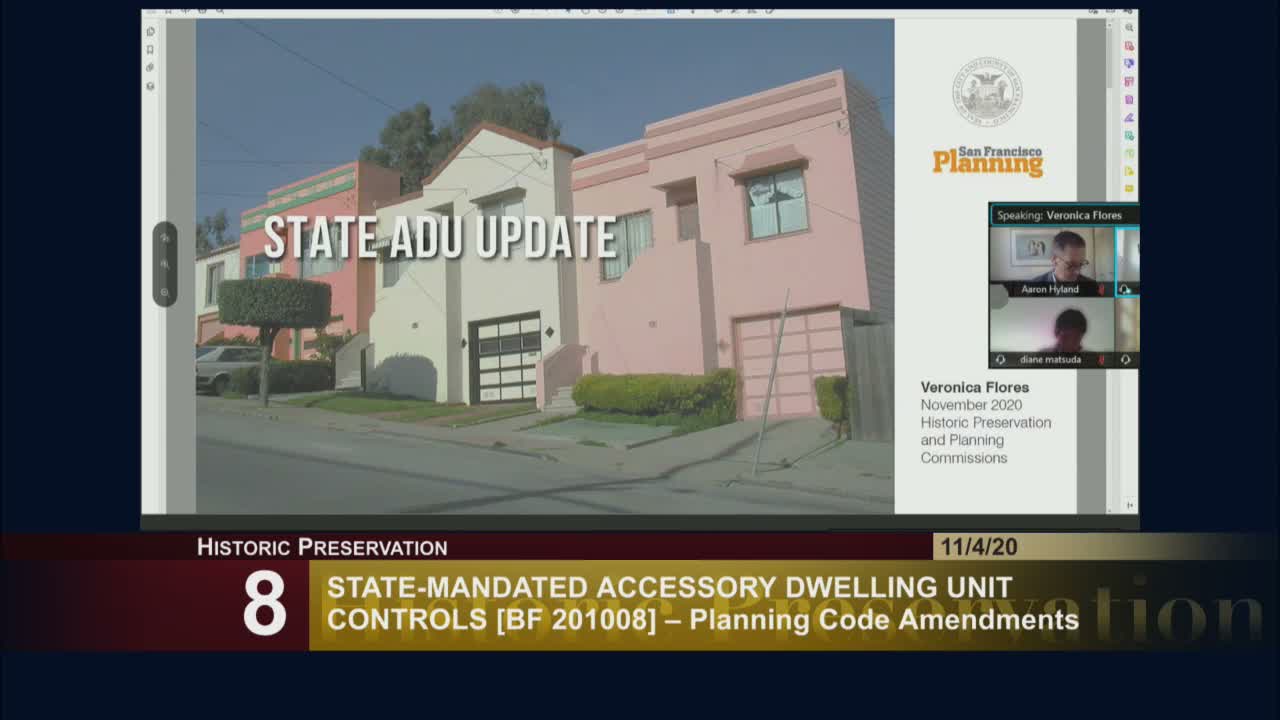
Planning Department staff presented a planning-code amendment on Nov. 4 intended to bring San Francisco’s accessory-dwelling-unit (ADU) regulations into compliance with recent state law changes. Veronica Flores summarized two main ADU paths under state law — "streamlined" and "ministerial" — and described a new junior-ADU category, a 60-day deadline for issuing permits for state-mandated ADUs, and proposed changes to Articles 10 and 11 to exempt qualifying state-mandated ADUs from Certificates of Appropriateness and Permit-to-Alter reviews.
"State law now requires that all permits for state mandated ADUs are issued within 60 days of receipt of a complete application," Flores said, noting the Planning Department launched an online ADU application process to help meet the deadline.
Commissioners asked how property owners choose between streamlined and ministerial paths, whether previously unauthorized units could be legalized, and whether removing the reference to the commission's objective architectural-review standards in the ordinance would limit future local options. Flores and ADU coordinator Natalia Kwiatkowski said many state-mandated ADU provisions are already effective and that the local code change primarily aligns the city with state requirements. Deputy City Attorney Peter Millingish said the City may not enforce local standards that conflict with state law but that the ordinance can advance while staff returns with a clear list of conflicts.
Commissioner Jones moved to recommend approval of the ordinance and to retain the architectural-review standards "insofar as they do not conflict with state law." The motion passed with a recorded roll call; staff and the City Attorney's Office will produce a list of standards that conflict with state law and revise them as needed.
The ordinance also clarifies impact‑fee treatment, noticing requirements for single-family conversions when tenants are present, and limits waivers of planning-code requirements primarily to ADUs within existing buildings.