Get Full Government Meeting Transcripts, Videos, & Alerts Forever!
Get email alerts on the Sb330 Housing topic
No spam. Unsubscribe anytime.
How California’s SB 330 changes application review and what it means for preservation
Summary
Planning staff briefed the commission on Senate Bill 330 (Housing Crisis Act of 2019), including its five‑year emergency period, preliminary housing application that locks in zoning and fee rules, limitations on new design standards to objective measures, and timing rules for local historic landmark designation relative to project applications.
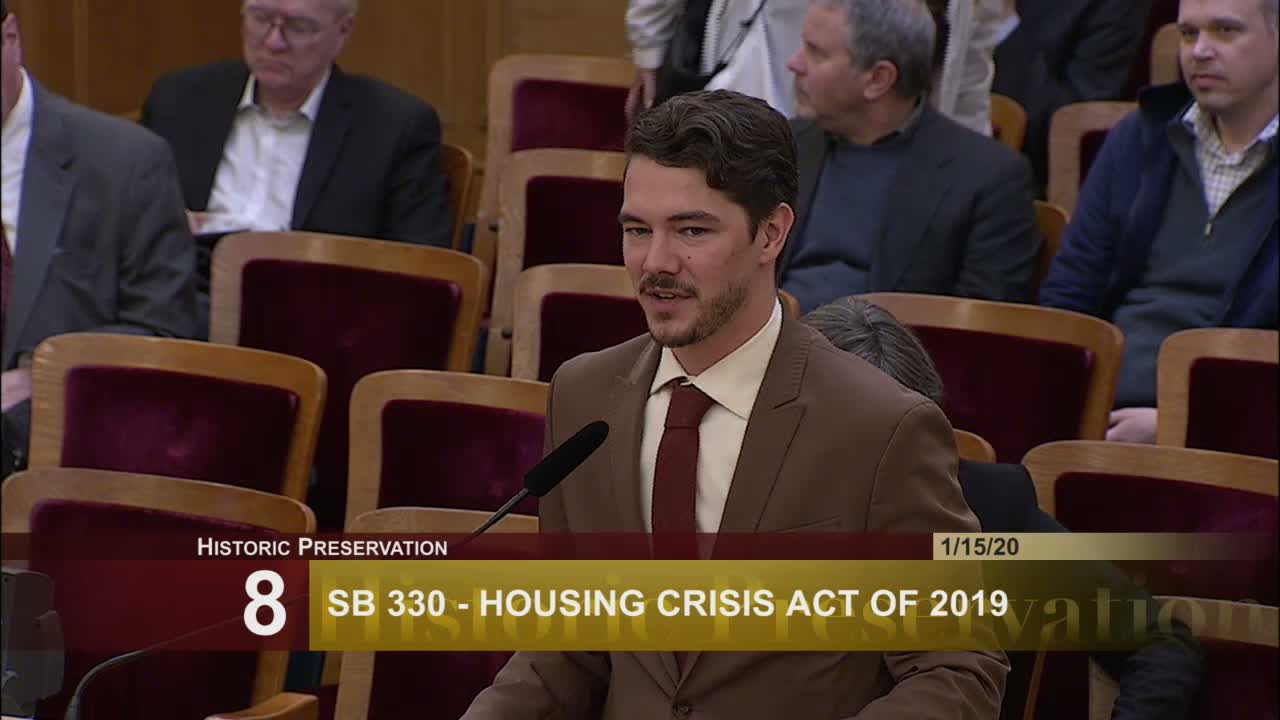
Planning Department staff provided the commission an overview of Senate Bill 330, the Housing Crisis Act of 2019, which took effect Jan. 1, 2020. Jacob Bentliff explained that the law declares a statewide housing emergency for five years and includes multiple provisions that affect how cities review housing projects during that period.
Key provisions cited to the commission included a prohibition on legislative or ballot‑measure actions that would reduce allowable housing capacity (the benchmark year is 2018), limits on new discretionary hearings for most code‑complying housing projects (a five‑hearing cap for the entire jurisdiction), and a restriction that newly adopted local design standards be objective (quantifiable checklist items that do not rely on subjective judgment).
The bill also establishes a preliminary housing development application that an applicant may file early in the process. If the applicant files a complete development application within six months of that preliminary filing, the project is ‘‘locked in’’ to the zoning, subdivision, and impact‑fee requirements that were in effect at the preliminary filing date; projects must commence construction within 30 months of approval or risk losing that protection.
Bentliff discussed how SB 330 affects historic‑resource work: if a property owner seeks local designation under Article 10 to protect a site, that designation application generally must be filed and acted on before an active development application is submitted on the same site. Bentliff emphasized that CEQA is not superseded by SB 330 and that historic resource evaluations and CEQA mitigation will continue to be applied where required.
Commissioners asked about applicability to HOME‑SF and state density bonus projects and whether applicants already in the system should file preliminary applications to lock in current rules; staff answered that applicants may elect to file a preliminary application and that informational guidance has been posted in Director’s Bulletin No. 7 on the department website.
The presentation was informational; commissioners did not take legislative action but discussed potential implementation questions for staff and applicants.