Get Full Government Meeting Transcripts, Videos, & Alerts Forever!
Get email alerts on the Academy Settlement topic
No spam. Unsubscribe anytime.
Historic Preservation Commission backs Academy of Art University settlement package, including $58M in payments and master permits for 12 historic properties
Summary
The commission unanimously adopted CEQA findings and recommended approval of planning code amendments, a development agreement and master permits/certificates affecting 12 historic Academy properties as part of a global settlement that includes about $58 million to the city and requirements to legalize and restore dozens of campus sites.
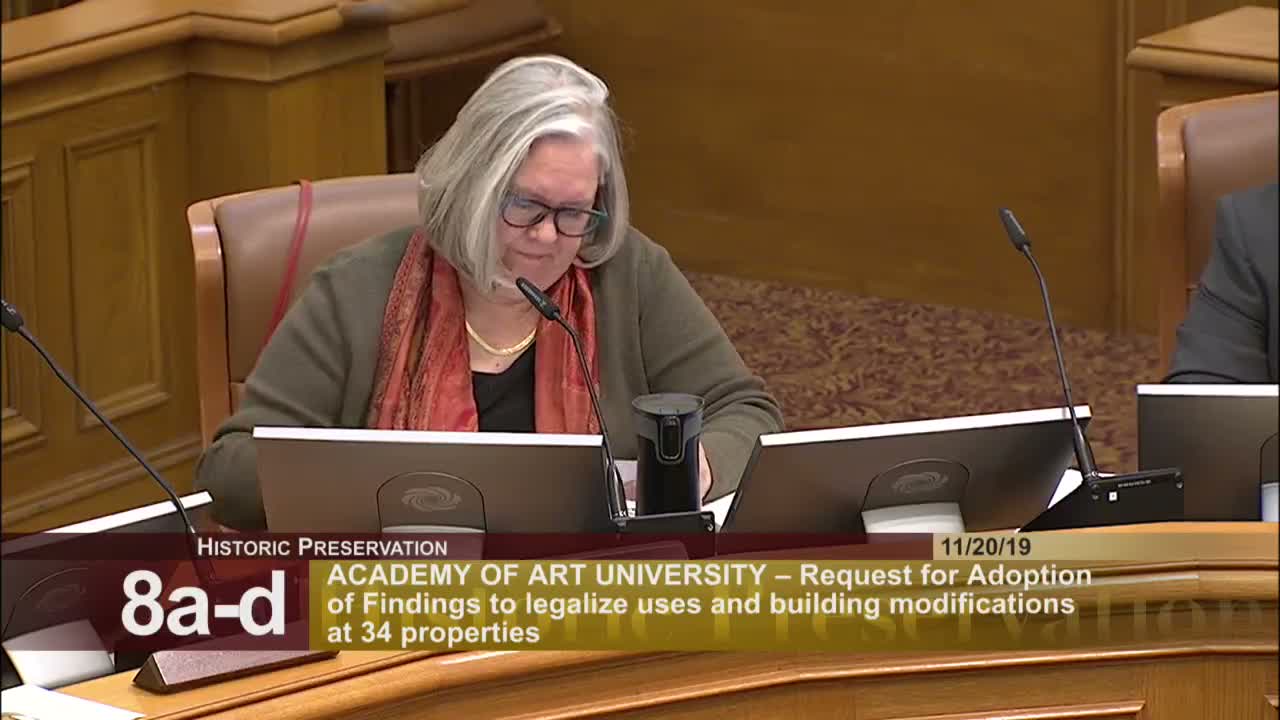
The Historic Preservation Commission on Wednesday adopted CEQA findings and voted to recommend approval of a development agreement, planning code amendments and a set of master permits and certificates of appropriateness that are part of a global settlement between the city and the Academy of Art University.
Scott Sanchez of the Planning Department summarized decades of enforcement and review, saying unpermitted conversions at Academy properties led to notices of violation beginning in 2007, litigation and a negotiated global term sheet that frames the current package. Andrew Perry and colleagues outlined the DA’s core elements: legalization and permitting of Academy uses at roughly 34 properties (including adding three properties and withdrawing uses at nine), corrective modifications for past unpermitted alterations, and various enforcement and timing provisions.
Perry said the development agreement anticipates an estimated $58,000,000 in payments by Academy affiliates to the city, including an affordable housing benefit of $37,600,000 to be used for affordable-housing purposes and an estimated $8,200,000 to the city’s small-sites fund, with the balance covering planning code civil penalties, enforcement cost reimbursements and impact fees. The agreement also includes student-housing metering provisions, a swap and consolidation of certain chapter 41 residential hotel rooms (a net addition of eight rooms subject to Chapter 41 requirements), and timelines for permit filing and construction.
Planning staff presented two sets of entitlement items: a master permit to alter for eight Article 11 conservation-district properties and a master certificate of appropriateness for four Article 10 landmarks. Staff-level presentations detailed proposed restorative scopes for each building — for example, window and storefront restorations, removal of nonhistoric awnings, replacement of incompatible lighting and relocation or legalization of signage — and concluded that the proposed work on balance would improve conformance with Secretary of the Interior standards.
Academy counsel Nick Roosevelt and project architect Paul Cooper described the restoration approach and reiterated program elements including a community facility proposed for 2225 Gerald Avenue and the DA’s 30-day advance notice requirement to planning staff for future filings. Public commenter Stuart Morton recommended further attention to the parapet/cornice at 540 Powell.
Commissioners praised the interdepartmental work and the comprehensive effort to resolve longstanding enforcement issues. The commission voted in a single roll call to adopt CEQA findings (including a statement of overriding considerations), recommend the ordinance and development agreement to the Board of Supervisors, and approve the master permit to alter and master certificate of appropriateness. The motion passed unanimously, 6-0. The matter will next proceed through the planning commission and then to the Board of Supervisors with a target of approvals effective by the end of the coming February; building permits are to be filed within 60 days of Board approval and most restoration work completed within 14 months (58 Federal allowed 20 months).