Get Full Government Meeting Transcripts, Videos, & Alerts Forever!
Get email alerts on the Budget Preservation topic
No spam. Unsubscribe anytime.
Planning Department outlines preservation staffing increases and budget constraints
Summary
Planning Department staff presented the FY2020–22 budget preview and a preservation work program showing increased preservation staffing (14.75 FTE to 21.3 FTE), add‑back funds for a citywide survey, and a fee study that could change department revenue. Commissioners pressed on staffing for cultural districts and legacy business support.
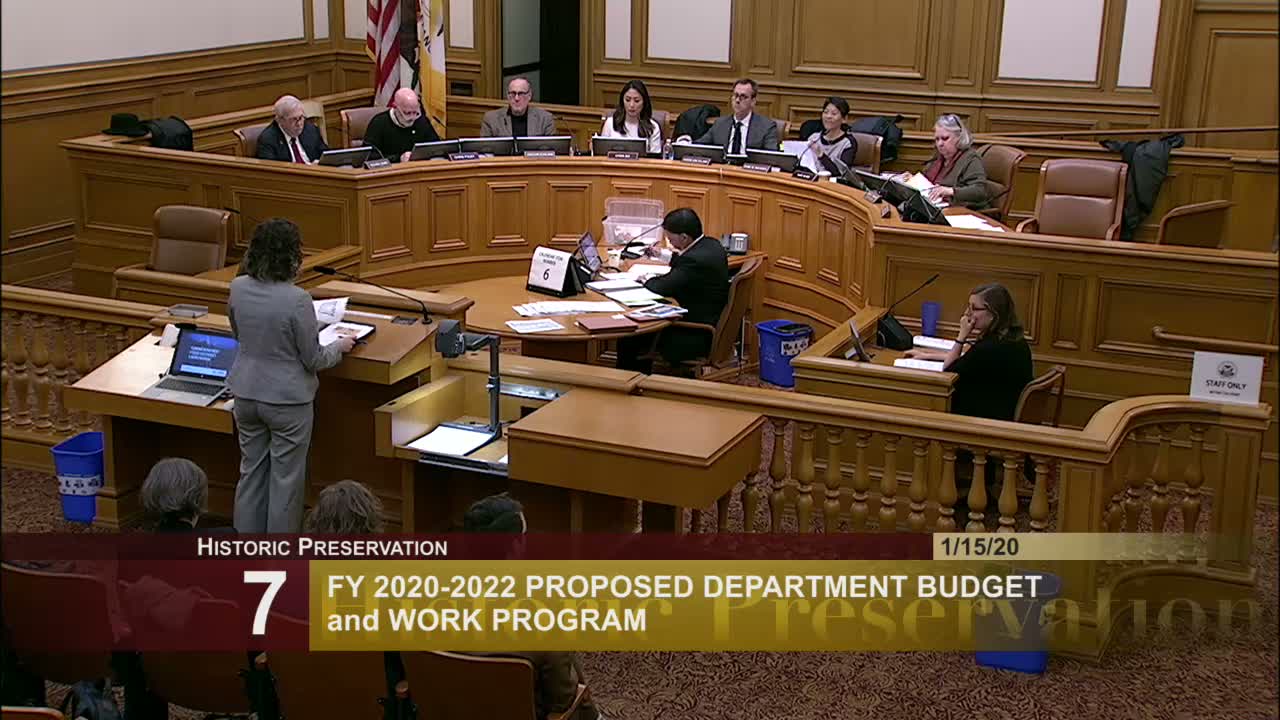
The San Francisco Planning Department on Jan. 15 presented an informational preview of its proposed budget and a more detailed preservation work program to the Historic Preservation Commission. Deputy Director of Administration Deborah Landis told the commission the department is projecting roughly 16,000 permit and planning items in the coming year, is largely fee‑funded, and is operating under a mayoral directive that discourages new positions amid a two‑year citywide shortfall the department said is about $420 million.
The presentation flagged two expense drivers: planned relocation to a costlier building and rising personnel costs. Landis said staff used a 3% CPI assumption for revenue projections pending final indexing and noted an ongoing fee study expected to conclude in March or April; any fee ordinance changes would accompany the department’s formal budget submission.
Jeff Joslin, director of current planning, presented the preservation program in detail. He said the department realigned duties across divisions and increased preservation‑related staffing from 14.75 full‑time equivalents in FY19–20 to 21.3 FTE in the revised work program (16 in current planning, 1.2 in citywide, 4.1 in environmental planning). Joslin said funding includes two annual $250,000 add‑backs for the citywide survey plus $200,000 from the historic preservation fund committee and anticipated grant support such as a $45,000 Certified Local Government (CLG) grant. The citywide survey will be ramped up under Marcel Boudreaux’s supervision and will use both new positions and consultant contracts.
Commissioners pressed staff about the staffing available to support newly established cultural districts and the legacy business program. Preservation staff Shelley Casagirone said cultural‑district work will be supported by the community equity team, which has assigned point people to districts, and that additional marketing and outreach coordination with OEWD and SF Bridal is underway. Joslin and Landis confirmed that add‑back dollars are intended to fund posted vacancies and that recruitment is underway.
The department also said it expects to more than double its contracts budget to cover expensive environmental impact reports for major efforts such as the Civic Center and the transportation and housing elements of the general plan. Landis said capital equipment needs were being reduced (for example, fewer plotters than previously budgeted) and that the department will aim to limit general‑fund exposure where possible.
The commission did not take any formal action on the budget during the informational hearing; staff said it will return Feb. 5 for the planning commission recommendation and later to the Board as required under the city’s budget calendar. The fee study and the department’s outreach on grant opportunities were identified as near‑term follow‑ups.