Get Full Government Meeting Transcripts, Videos, & Alerts Forever!
Get email alerts on the Retained Elements topic
No spam. Unsubscribe anytime.
Planning staff presents draft 'retained elements' guidelines as stakeholders urge clearer limits on use for historic resources
Summary
Planning staff presented draft 'retained elements' special topic design guidelines, framing them as discretionary design-review guidance to preserve selected building elements. San Francisco Heritage urged clearer criteria and asked staff to prohibit using the guidelines for individually listed or eligible historic resources; staff said the draft is intended for design review, not to replace preservation standards.
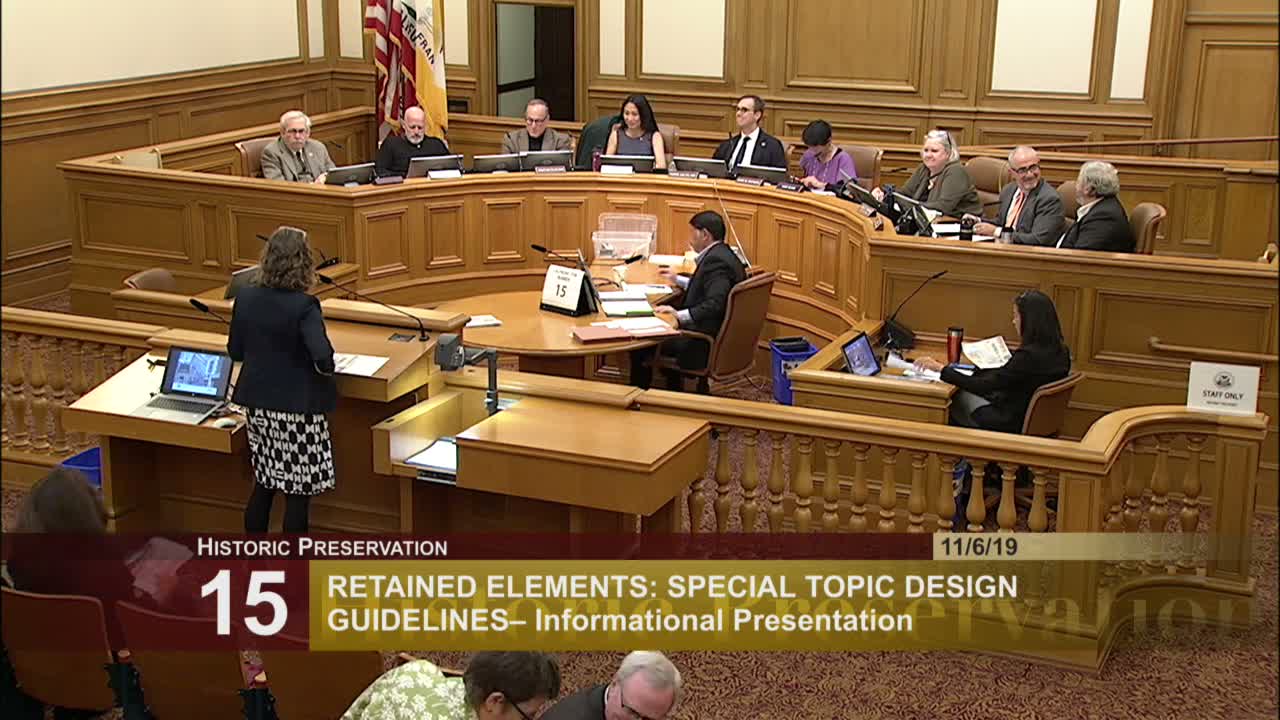
Planning Department staff returned to the Historic Preservation Commission on Oct. 2 with draft "retained elements" special topic design guidelines intended to guide how parts of existing buildings might be retained and integrated into new projects.
"Retained elements really is a broader conversation, beyond historic preservation," Maya Small, planning department staff, told the commission. She described the draft as voluntary guidance focused on how to retain existing features respectfully — site, architecture and public realm — and said the intent is to make the design review process more inclusive of cultural expression and neighborhood identity.
Staff emphasized the guidelines are discretionary and do not change rehabilitation standards: they "will not achieve conformance with the Secretary of the Interior Standards for the treatment of historic properties," Small said. Staff also told commissioners the passage of SB 330 (referenced by staff) has created urgency to finalize guidance that is not objective design regulation before statutory restrictions take effect, and that the Planning Commission is the intended adopting body.
Woody Labownie of San Francisco Heritage told the commission the draft lacks specific criteria for when the guidelines would be applied during alternatives development in an environmental review, and urged the department to "further prohibit application of the guidelines to historic resources that are individually listed in or eligible for the California Register of Historic Resources or the National Register of Historic Places." Labownie said the absence of explicit criteria could allow retained‑element approaches to be used in ways that harm historic resources.
Commissioners pressed staff for clearer process language, more and better visual examples (do/don't photos and 3‑D diagrams), and a flowchart showing when the guidelines would be used in design review and when preservation or CEQA processes would control. Several commissioners suggested removing vague phrasing such as "in rare cases" and asked staff to clarify how retained‑element alternatives relate to partial or full preservation alternatives in an EIR.
Staff and department leadership reiterated the draft is intended as design‑review guidance (not rehabilitation) and invited further written comments; they said they hope to present a revised draft to the Planning Commission in December. Commissioner feedback focused on tightening applicability language, producing clearer examples, and documenting process steps for when retained elements may be proposed during environmental review.