Get Full Government Meeting Transcripts, Videos, & Alerts Forever!
Get email alerts on the Adaptive Reuse topic
No spam. Unsubscribe anytime.
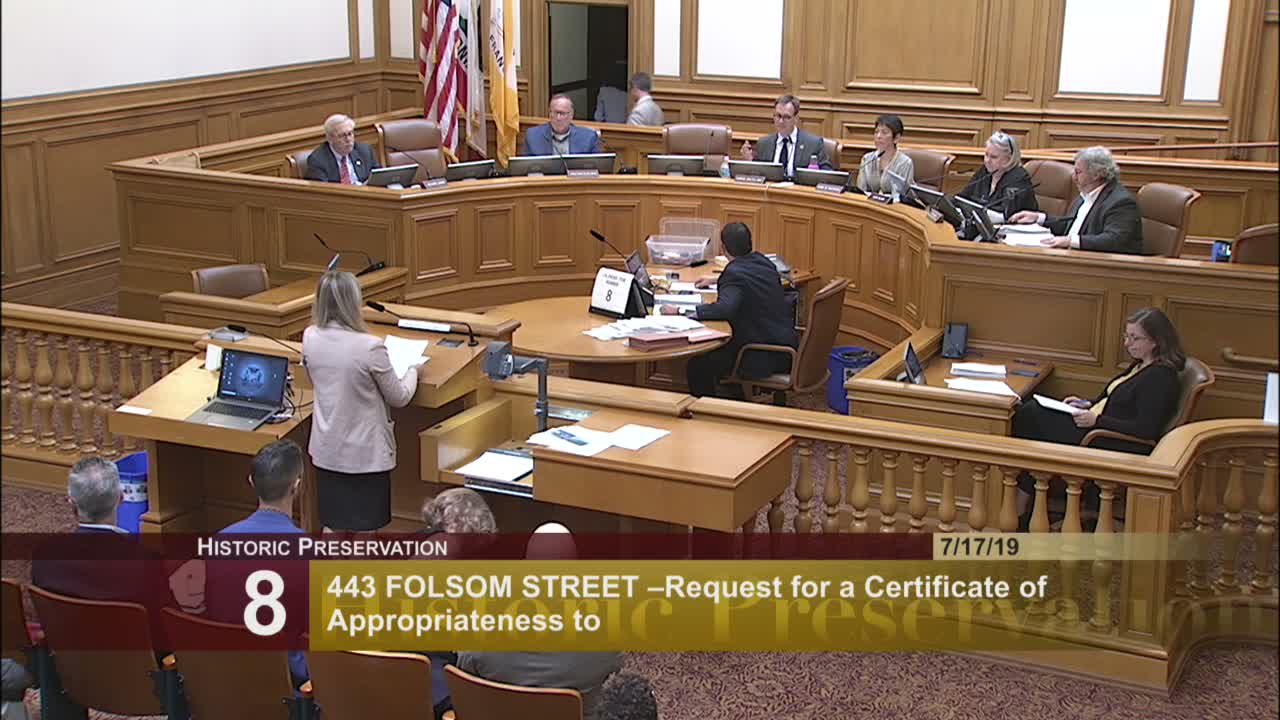
Commission approves COA to convert historic Edwin Clacker’s Blacksmith Shop to cannabis retail at 443 Folsom
Summary
The commission approved a certificate of appropriateness for 443 Folsom Street (landmark #149, Edwin Clacker’s Blacksmith Shop) to allow exterior restoration and an interior remodel for cannabis retail, with conditions including adherence to a conservation report and staff review of field changes.
On July 17 the Historic Preservation Commission approved a certificate of appropriateness for work at 443 Folsom Street — the historic Edwin Clacker’s Blacksmith Shop — that would adapt the early-20th-century building for cannabis retail use.
Department staff (Natalia Kwiatkowski) explained the proposed scope: exterior facade restoration based on historic evidence, repair/replacement of sheet-metal cladding, rear footprint modifications to add a second exit, structural upgrades, and interior remodeling to accommodate retail use. The department recommended approval with conditions including adherence to the conservation report, notification of staff for any changes, and a site visit prior to occupancy for compliance verification.
Project sponsor Travis Kelly and architect Lisa Harvey described the building’s family-owned history and their approach to preserving the building’s character while making it viable for reuse; the project team asked the commission to reconsider condition 2’s wording to avoid unnecessary additional consultants while agreeing to the intent requiring professional oversight if field conditions exceed the conservation report. Commissioners worked through wording changes to condition 2 so that project sponsors must notify staff if replacement or framing exceeds the conservation report, after which staff would direct appropriate treatments or qualified professionals.
Commissioners expressed support for preserving key public spaces and minimizing intrusive replacements. After discussion and amendment of condition 2 the commission moved to approve the COA; the motion passed unanimously (5–0). The department will require the project sponsor to follow the revised condition and provide staff with required documentation and mock-ups where indicated.