Get Full Government Meeting Transcripts, Videos, & Alerts Forever!
Get email alerts on the Cultural Districts topic
No spam. Unsubscribe anytime.
Historic Preservation Commission backs ordinance to create Castro LGBTQ cultural district with community-led safeguards
Summary
The Historic Preservation Commission unanimously recommended approval of an administrative-code amendment to establish a Castro LGBTQ Cultural District, adding language to name the commission a technical advisor and to emphasize the district must be community-led. The commission also urged close coordination with MOHCD and the city's LGBTQ cultural heritage strategy.
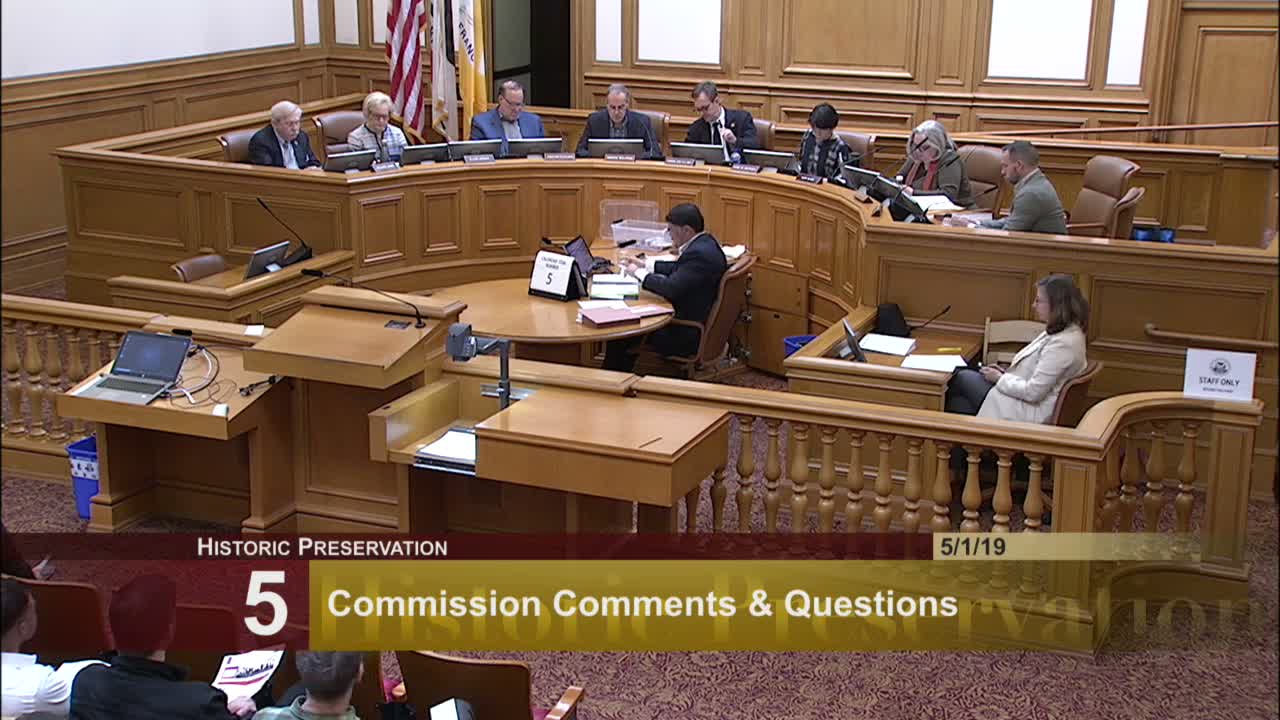
The San Francisco Historic Preservation Commission on May 1 recommended that the Board of Supervisors adopt an amendment to the Administrative Code to establish the Castro LGBTQ Cultural District, voting unanimously after adding language to clarify the commission’s advisory role and to require that any community-based organization act in partnership with the neighborhood working group.
Preservation staff told commissioners the proposal (case no. 2019-005451 PCA) aligns with the citywide historic context statement for LGBTQ history and the city’s forthcoming LGBTQ+ cultural heritage strategy. ‘‘We recommend approval without any modification,’’ staff said, citing the district’s deep historical connection to LGBTQ life and its institutions.
Tom Temprano, legislative aide to Supervisor Mandelmann, said the ordinance grew from a neighborhood process that began in 2017 and that the proposed boundaries reflect extensive community input. He told the commission the district would include community-serving institutions such as the SFLGBT Center and the National LGBTQ Center for the Arts and that, with passage of Proposition F, the Castro would be eligible to access dedicated funding for cultural districts.
Sean Haines, speaking for the Castro working group, described a decline in neighborhood events and institutions and urged commissioners to act. ‘‘We don’t have a Pink Saturday — it no longer exists in the Castro,’’ Haines said, arguing that district designation would provide resources to ‘‘keep the Castro queer and safe and inclusive for all.’’
Commissioners asked detailed questions about governance, MOHCD’s role in selecting a fiscal sponsor, and how the citywide cultural-heritage strategy would relate to district-level decisions. Staff and Temprano explained that the cultural heritage strategy serves as a citywide ‘‘tool chest’’ and that each cultural district would have autonomy to choose which tools or programs to use. They also said MOHCD must generally issue competitive solicitations for public funds, and that community working groups typically partner with a nonprofit fiscal sponsor to receive city funding.
Commissioner discussion produced two clarifying amendments the commission endorsed: adding the Historic Preservation Commission specifically as a technical advisor in the ordinance language (page 14), and inserting an asterisk on page 15 to emphasize that the district is a community-led effort and that a single nonprofit fiscal sponsor does not replace the community working group. Staff agreed to work with the City Attorney’s office on final language.
The commission voted to recommend approval as amended. The motion passed unanimously, 7–0. The commission’s recommendation now moves to the Board of Supervisors for further consideration.
If adopted by the Board, the ordinance sets a deadline of June 30, 2021, for development of the CHESS (Cultural History Economic Sustainability Strategy) report referenced in staff materials. Staff and Temprano emphasized ongoing coordination between the district working group, MOHCD (Mayor’s Office of Housing and Community Development), and planning staff for governance and funding details.