Get Full Government Meeting Transcripts, Videos, & Alerts Forever!
Get email alerts on the Mills Act Amendment topic
No spam. Unsubscribe anytime.
Commission backs code change to let Mills Act applications be filed with designation requests
Summary
The commission unanimously recommended approval of a Planning Department code amendment to allow property owners to file Mills Act contract applications concurrently with local designation applications, aiming to expand eligibility and incentivize historic designation.
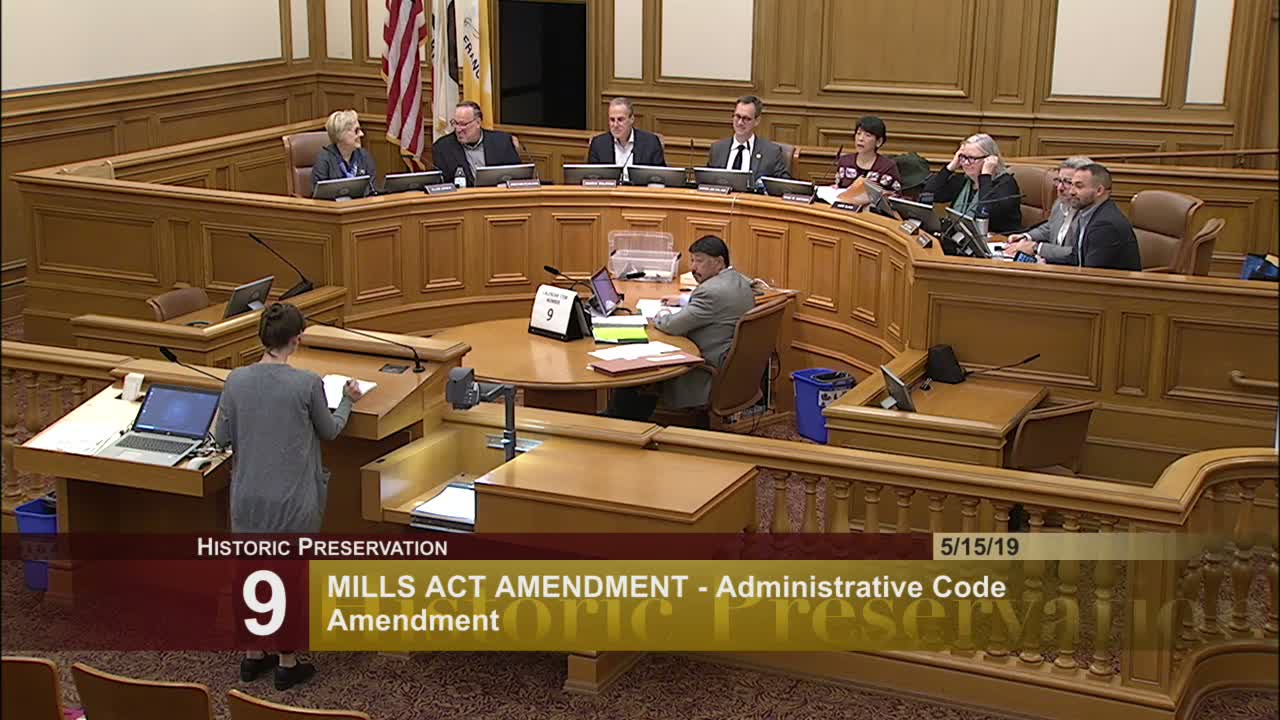
The San Francisco Historic Preservation Commission voted on May 15, 2019, to recommend approval of a proposed amendment to the Mills Act administrative code that would allow property owners to submit Mills Act contract applications concurrently with applications for local historic designation.
Michelle Taylor of Planning Department staff said the change—proposed by Supervisor Peskin and presented for commission review—would alter Administrative Code Chapter 71 to permit concurrent filing and community review. Under current rules, Mills Act eligibility is limited to properties designated on or before December of the year before the Mills Act application is filed; the amendment would leave substantive designation eligibility intact but allow the application timing to be concurrent, increasing incentives for owners to seek designation.
Commissioners asked about process safeguards if a concurrent designation application fails and about documentation requirements. Staff said applicants would still submit the designation report and rehabilitation and maintenance plan required for designation, and could withdraw the Mills Act application if the designation did not meet the commission’s threshold. Staff also said the department had revised application documents and clarified expectations for approvals tied to the first three years of a rehabilitation plan.
Commissioner Wolfram moved to recommend approval of the ordinance amendment and the motion passed unanimously, 6–0. The Planning Department will forward the recommendation to the Land Use Committee before consideration by the full Board of Supervisors.
Next steps: staff will send the commission’s recommendation to the Land Use Committee; applicants can expect concurrent hearings to be scheduled once the ordinance proceeds through legislative review.