Get Full Government Meeting Transcripts, Videos, & Alerts Forever!
Get email alerts on the Cultural Districts topic
No spam. Unsubscribe anytime.
Historic Preservation Commission backs African American arts and cultural district for Bayview Hunters Point
Summary
After public testimony and staff discussion about deadlines and staffing for CHESS reports, the San Francisco Historic Preservation Commission unanimously recommended that the Board of Supervisors approve PCA‑2018‑015807 to establish an African American Arts and Cultural District in Bayview Hunters Point, with amendments to soften timing and clarify the CAC’s advisory role.
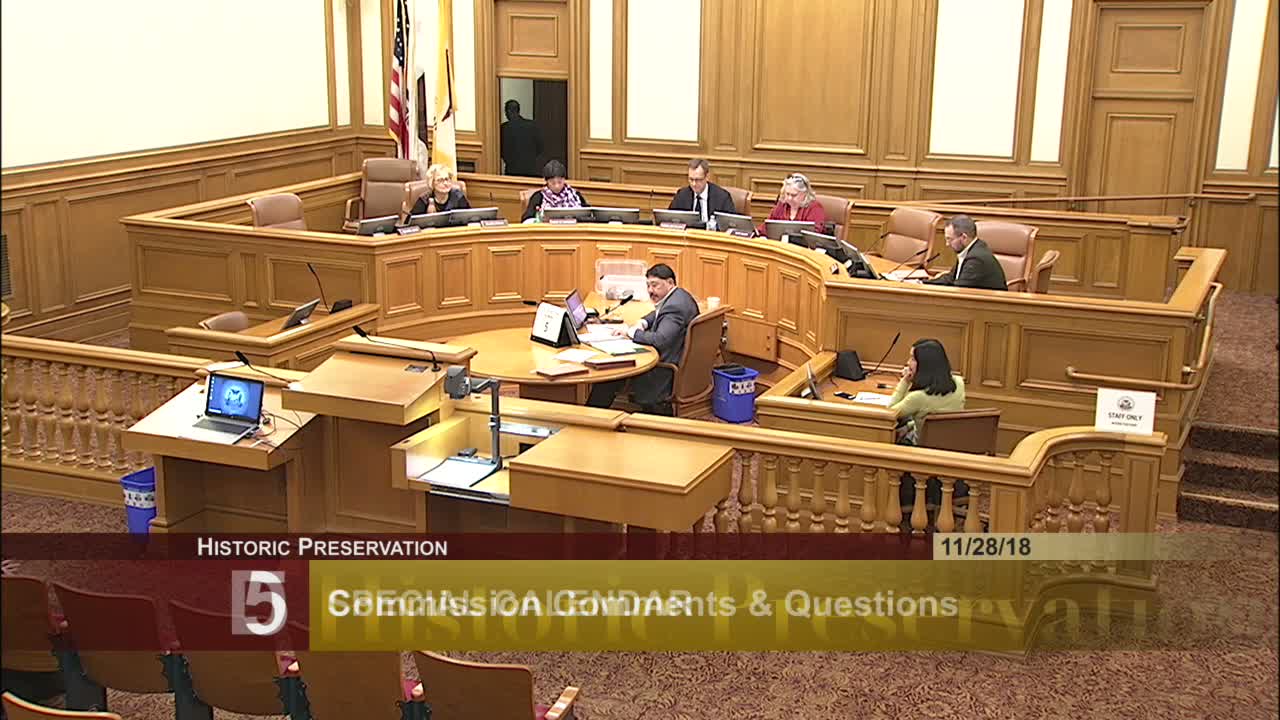
The San Francisco Historic Preservation Commission voted unanimously Nov. 28, 2018 to recommend that the Board of Supervisors approve PCA‑2018‑015807, an administrative‑code ordinance to establish an African American Arts and Cultural District in Bayview Hunters Point.
The commission’s action follows hours of presentations and public comment from community leaders, preservation staff and the ordinance sponsor, Board of Supervisors President Cohen. The measure, as described by preservation staff, would designate the district, require city departments to submit written reports describing cultural attributes and preservation strategies, and create a Community Advisory Committee (CAC) to advise the city.
Preservation staff asked the commission to adopt three technical amendments to improve the ordinance’s implementation. Staff recommended replacing fixed report deadlines with greater flexibility, allowing the CAC to re‑examine proposed district boundaries after reviewing the CHESS (Cultural History, Housing, Economic Sustainability Strategy) report, and acknowledging that producing an additional CHESS report would affect staff workloads and timing. Staff noted a July 1, 2019 reporting date and an October 2019 CHESS deadline in the draft ordinance and described those timelines as a “tight turnaround” given existing survey and intangible‑resource work.
Devin Richardson, co‑chair of the community working group, and multiple public commenters urged the commission to move the ordinance forward. Eloise Patton, chair of the Bayview CAC, told commissioners the district would enable strategies to retain and recruit African American residents. Tyra Fennell of Imprint City, and Barbara O'Kel of the Bayview Opera House, among others, said an arts‑led cultural district could spur local economic activity and recommended that the district include the full Bayview Hunters Point neighborhood.
Brian Chu of the Mayor’s Office of Housing and Community Development said his office strongly supports the resolution but cautioned that creating multiple CHESS reports within the proposed schedule would require more staffing or consultants; he suggested Prop F funds and consultant support as possible resources. Cheryl Davis, director of the Human Rights Commission, also voiced full support and said surveys of hundreds of residents found many African Americans feel "invisible" in the city.
Commissioners praised the community work and endorsed the staff’s suggested changes. Preservation staff refined their language during the hearing, proposing that the ordinance require the CAC to provide a six‑month progress report rather than embedding multiple fixed deadlines, and that the CAC make formal boundary recommendations to the Board of Supervisors rather than have final boundary authority. Commissioners said they would press the Board of Supervisors and departments to address staffing and budget needs during upcoming budget hearings.
Commissioner Matsuda made the motion to recommend approval with amendments, which Commissioner Black seconded. Commissioners Black, Jonk, Matsuda and Chair Hyland voted yes; the motion passed 4–0. The commission’s recommendation is advisory; final enactment requires Board of Supervisors action.
The commission adjourned after the vote. The ordinance and the commission’s recommended amendments will proceed to the Board of Supervisors for consideration.