Get Full Government Meeting Transcripts, Videos, & Alerts Forever!
Get email alerts on the Landmark Designation topic
No spam. Unsubscribe anytime.
Historic Preservation Commission approves Maryvale site project 4–3 after heated debate over gardens and period of significance
Summary
After extensive public testimony and internal debate over whether Maryvale’s gardens and garden shop are contributing features of City Landmark No. 58, the commission rejected a continuance and approved a Certificate of Appropriateness for a four‑story, eight‑unit building at 3620 Buchanan Street on a 4–3 vote. Commissioners and neighbors disagreed about the landmark boundary and whether additional study or design changes were needed.
The Historic Preservation Commission voted 4–3 to approve a Certificate of Appropriateness for a proposed four‑story, eight‑unit building at 3620 Buchanan Street, a site that includes City Landmark No. 58 (the Maryvale Antiques / San Francisco Gaslight Company administration building), after a contentious public hearing in which neighbors and preservationists urged a continuance.
Staff had recommended approval with conditions. Stephanie Cisneros, preservation staff, told commissioners the project would demolish a non‑contributing one‑story garden house and portion of the non‑historic courtyard and that Page & Turnbull’s historic‑resource evaluation concluded those elements are not contributing features to the landmark. Staff’s recommended conditions include submission of final materials and window details as part of the site‑permit submittal and a site visit by preservation staff prior to occupancy to verify compliance.
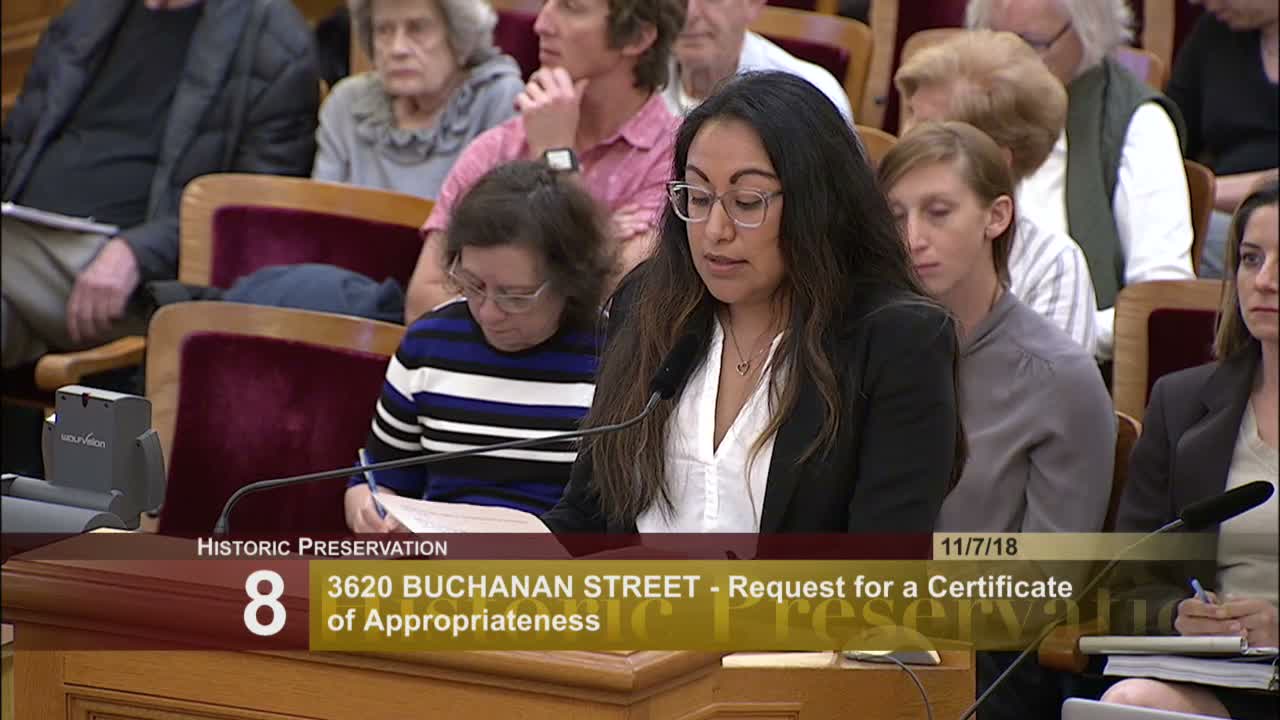
Speakers opposing the project argued the landmark designation and the original ordinance and recorded documents describe an L‑shaped lot that includes the garden and garden shop and say those elements should be treated as part of the historic asset. Arnold Cohen and multiple long‑time neighbors presented historic ordinance citations, assessor parcel diagrams and legally recorded descriptions they said support that interpretation; Gigi Platt, a longtime neighbor, described the project as encroaching on open space and called the proposal an overbuild.
Commissioner discussion focused on two questions: whether the garden and garden house should be considered contributing features and whether design changes (massing and setbacks) or further study of the site's period of significance were warranted. Commissioner Hyland moved to continue the matter so staff and the community could further evaluate those issues. That motion was seconded, then failed on a 3–4 roll call. An alternate motion to approve the project was moved and seconded; the roll call on approval was 4 in favor (including Commissioners Johns, Pearlman and President Wolfram) and 3 opposed (Commissioners Jonk, Matsuda and Hyland).
Several commissioners stated they remained concerned about the period‑of‑significance question and about preserving open space but concluded the Page & Turnbull analysis and staff review supported the finding that the garden house and patio are non‑contributing due to alterations in the 1990s and the relevant ordinance language. Staff and the applicant said design revisions had addressed Architectural Review Committee comments and the new building would be set back to preserve sightlines to the landmark building.
The commission’s action sends the project forward with the staff‑recommended conditions; opponents said they would review next steps available to them through the Planning Commission and the Board of Supervisors.
Vote at a glance: continuance motion failed 3–4; approval motion passed 4–3.