Get Full Government Meeting Transcripts, Videos, & Alerts Forever!
Get email alerts on the Historic Preservation topic
No spam. Unsubscribe anytime.
Commission recommends six Mills Act contracts and reviews application changes amid debate over retroactivity and priorities
Summary
The commission recommended approval of six Mills Act historical property contracts to the Board of Supervisors and spent the remainder of the hearing reviewing proposed changes to the Mills Act application packet, including new priority criteria, a ban on properties with outstanding violations, limits on retroactive claims and required minimum scopes of work; commissioners debated effects on owners who bought neglected properties and whether accessory dwelling unit work should be eligible.
The San Francisco Historic Preservation Commission moved to recommend six Mills Act contract applications to the Board of Supervisors and conducted an extended review of proposed amendments to the Mills Act application packet on Oct. 3.
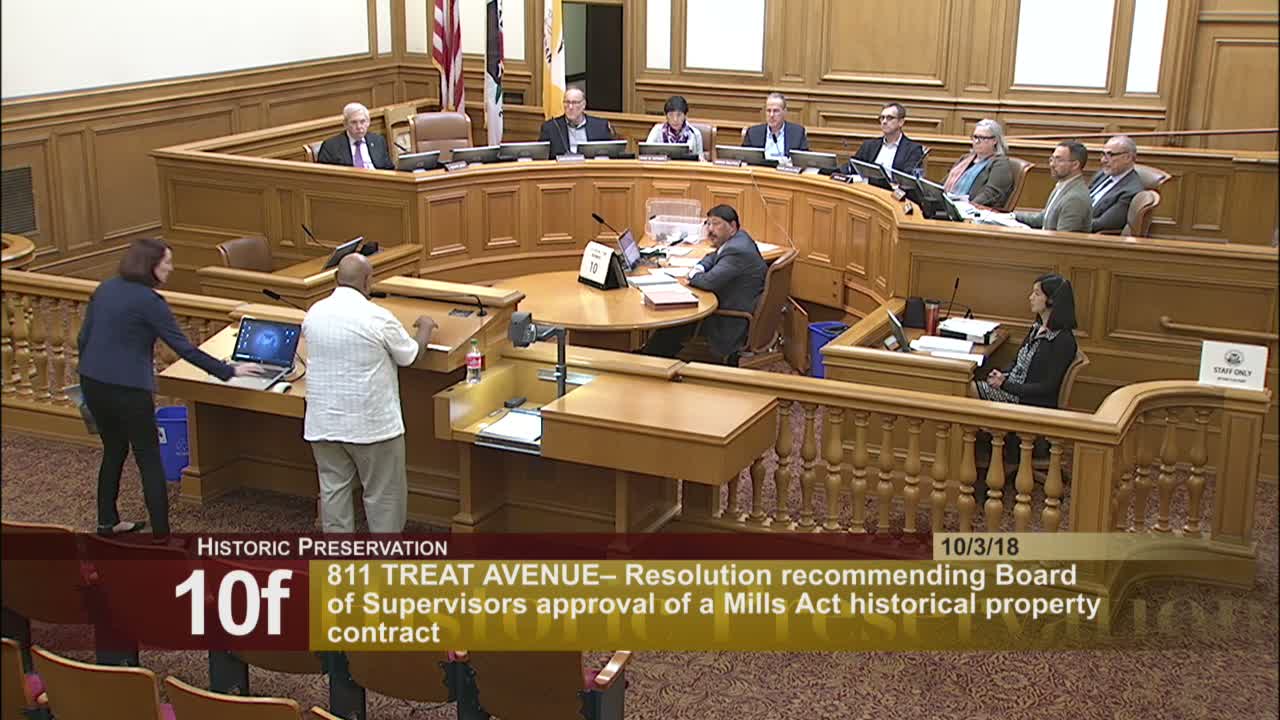
Planning staff (Shannon Ferguson) presented six properties proposed for Mills Act contracts — 2253 Webster Street; 353 Kearny Street; 465–467 Oak Street (Russell Warren House); 587 Waller Street; 354–356 San Carlos Street; and 811 Treat Avenue (the Henry Gilfas House). For each parcel staff summarized the building’s historic character, an owner‑proposed 10‑year rehabilitation plan, estimated rehabilitation and annual maintenance costs, and the assessor’s draft valuation used to estimate property‑tax savings. Examples from the staff presentation: the applicant for 2253 Webster had completed dry rot repairs in 2017 and proposed $87,000 in work over 10 years with maintenance estimated at $3,500 annually; 353 Kearny’s rehabilitation was estimated at over $1,000,000 over 10 years with an estimated tax savings of $26,963; 465–467 Oak Street’s 10‑year rehabilitation was estimated at $369,600 with $16,250 in potential tax savings.
After the staff presentation several property owners and preservation advocates spoke in support. Jim Warshall, president of the San Francisco Victorian Alliance, urged approval and noted the program’s role in incentivizing long‑term maintenance; an owner of 465–467 Oak Street (Joe Laska) described steep foundation and roof work estimated at roughly $370,000 and said the proposed tax savings would meaningfully offset future costs.
The commission then reviewed proposed amendments to the Mills Act application packet intended to respond to prior Government Audit and Oversight (GAO) Committee concerns. Staff proposed a set of priority consideration criteria — necessity (demonstrated financial need and preservation risk), investment (owner commitment to substantial rehabilitation), distinctiveness, protection of legacy businesses, and recently designated city landmarks — and recommended that properties with outstanding department or planning enforcement violations not be eligible until violations are corrected. Staff also proposed limiting the extent of retroactive work eligible for contract consideration (work completed before the contract should generally not be factored) and requiring that prioritized scopes of work be completed within the first 10 years, with certain critical work prioritized in the first three years.
Commissioners debated several points. Some members worried that barring properties with prior violations could penalize new owners who purchased a deteriorated property and discourage rehabilitation; other members and staff pointed to GAO concerns that retroactive large‑scale rehabilitation undermines the program’s purpose as an incentive. Commissioners asked staff to refine language to distinguish deliberate, unpermitted alterations from long‑term deferred maintenance and to consider allowing narrowly defined recent emergency or necessary repairs to be eligible. The commission also discussed whether permitting accessory dwelling unit (ADU) conversions to qualify under Mills Act scopes would be an appropriate incentive to add housing while supporting façade restoration and seismic retrofits.
Public comment during the Mills Act agenda included a critical speaker (Gregory Williams) who raised concerns about cost and enforcement and framed affordability and inspection priorities as civic concerns; Jim Warshall and other preservation advocates urged approval of the presented applications. After public testimony and deliberation the commission recommended approval of all six Mills Act applications to the Board of Supervisors; the staff presentation and motion record indicate the recommendation and the roll call vote in favor.
Next steps: Staff will revise the draft Mills Act application packet to reflect the commission’s feedback, coordinate with the City Attorney and GAO committee on final amendments, and bring revised language back to the commission and the Board of Supervisors for consideration.