Get Full Government Meeting Transcripts, Videos, & Alerts Forever!
Get email alerts on the Historic Resources topic
No spam. Unsubscribe anytime.
Planning staff: Draft EIR finds demolition of Fillmore‑era building would be a significant, unavoidable impact
Summary
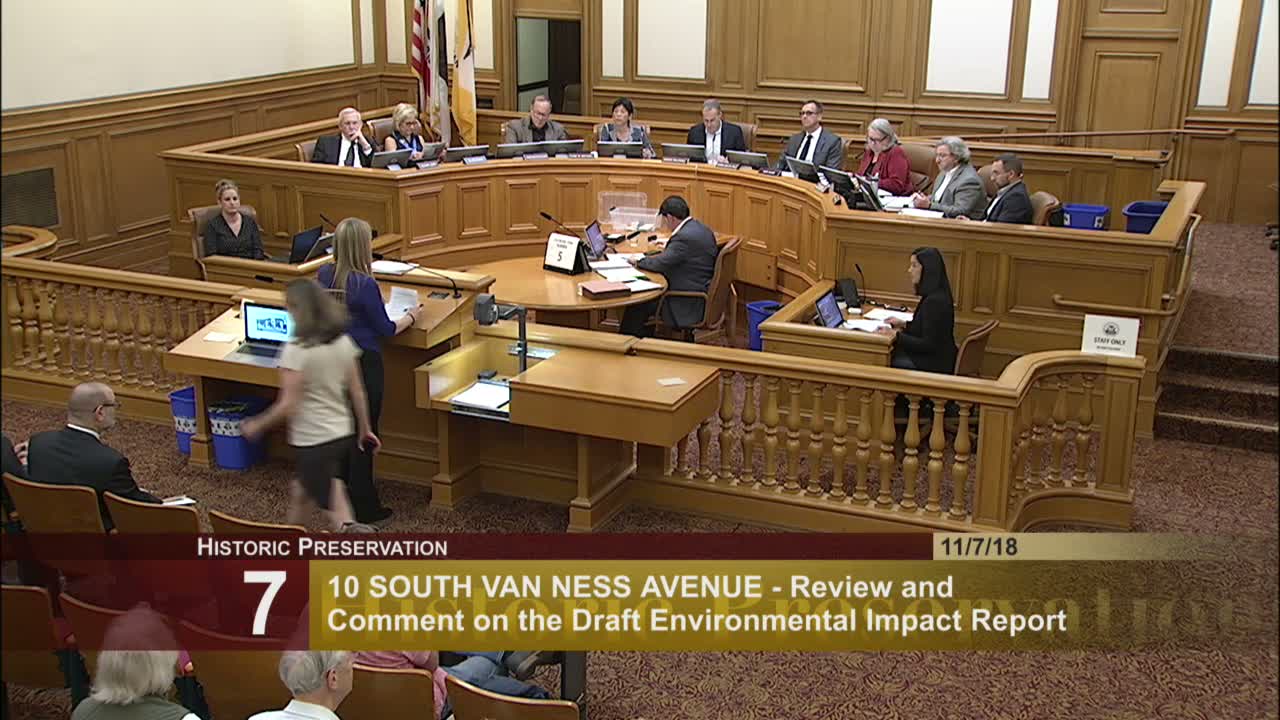
Planning department staff told the Historic Preservation Commission the draft environmental impact report for 10 South Venice Avenue concludes demolition of a building eligible for the California Register (associated with the Fillmore/Carousel/Fillmore West) would be a significant, unavoidable CEQA impact; staff presented mitigation requiring HABS‑style documentation and described alternatives including partial and full preservation but said full preservation is constrained by the BART tunnel.
Planning department staff presented the draft environmental impact report (EIR) for a proposed redevelopment of 10 South Venice Avenue and concluded that demolishing the site’s existing building — identified as individually eligible for the California Register for its association with the Fillmore/Carousel (Fillmore West) and promoter Bill Graham — would cause a project‑level, significant and unavoidable impact under the California Environmental Quality Act (CEQA).
Rachel Shut, environmental‑review coordinator for the project, told the Historic Preservation Commission the proposal includes two possible envelopes: a two‑tower scheme (two 41‑story towers, about 420 feet) or a single 55‑story (about 590 feet) tower. The draft EIR found the 1926–27 building retains sufficient integrity to convey its historical significance under California Register criteria for events and persons and therefore qualifies as a historic resource under CEQA; demolition would therefore materially impair that resource.
As mitigation, the draft EIR identifies a package based on Historic American Buildings Survey (HABS)‑style documentation: measured drawings, high‑level photography, a historic report, salvage of materials of interest, permanent interpretive displays and a print‑on‑demand book. Staff said that package would reduce the loss to the existing resource but would not eliminate the CEQA impact; the report therefore treats the impact as significant and unavoidable.
The draft EIR analyzes five alternatives, including a no‑project alternative, two full‑preservation alternatives and two partial‑preservation alternatives. Staff said full preservation alternatives were developed in consultation with the department’s Architectural Resources Committee but that one full‑preservation option was ultimately determined infeasible because of the presence of the BART tunnel and its zone of influence beneath the northern portion of the site.
Public testimony emphasized the building’s cultural importance. Local residents and preservation advocates recalled concerts at the Carousel Ballroom and the Fillmore West and urged broader mitigation: Mike Bueller of San Francisco Heritage asked that mitigation include funding for a citywide context study of 1960s counterculture and music venues to inform interpretation, while other speakers requested that oral histories and audiovisual materials be part of any mitigation package.
Commissioners debated the adequacy and scope of mitigation and the feasibility tradeoffs between preservation and housing yield. Several said they supported stronger interpretive measures and the option for the sponsor to expand the mitigation scope; staff noted the mitigation language (MCR‑1B) requires a music‑venue study tied to the site but allows the sponsor to expand the scope by election.
The commission’s role at this hearing was advisory: to receive public testimony, discuss historic‑resources issues in the draft EIR and formulate comments the commission may submit to the Planning Commission. A public hearing before the Planning Commission was scheduled for Dec. 6, and the draft EIR public‑review period runs through Dec. 11.
The commission did not take a final preservation vote at this meeting; staff and the project sponsor remained available to answer clarifying questions and the record remained open for the Planning Commission process.