Get Full Government Meeting Transcripts, Videos, & Alerts Forever!
Get email alerts on the Historic Preservation topic
No spam. Unsubscribe anytime.
Historic preservation commission backs citywide LGBTQ cultural-heritage strategy
Summary
The San Francisco Historic Preservation Commission heard a presentation on a citywide LGBTQ cultural heritage strategy built from nearly 1,500 community survey responses and endorsed short-term steps including an advisory group, navigation tools and workforce supports; commissioners asked staff for measurable performance steps and outreach plans.
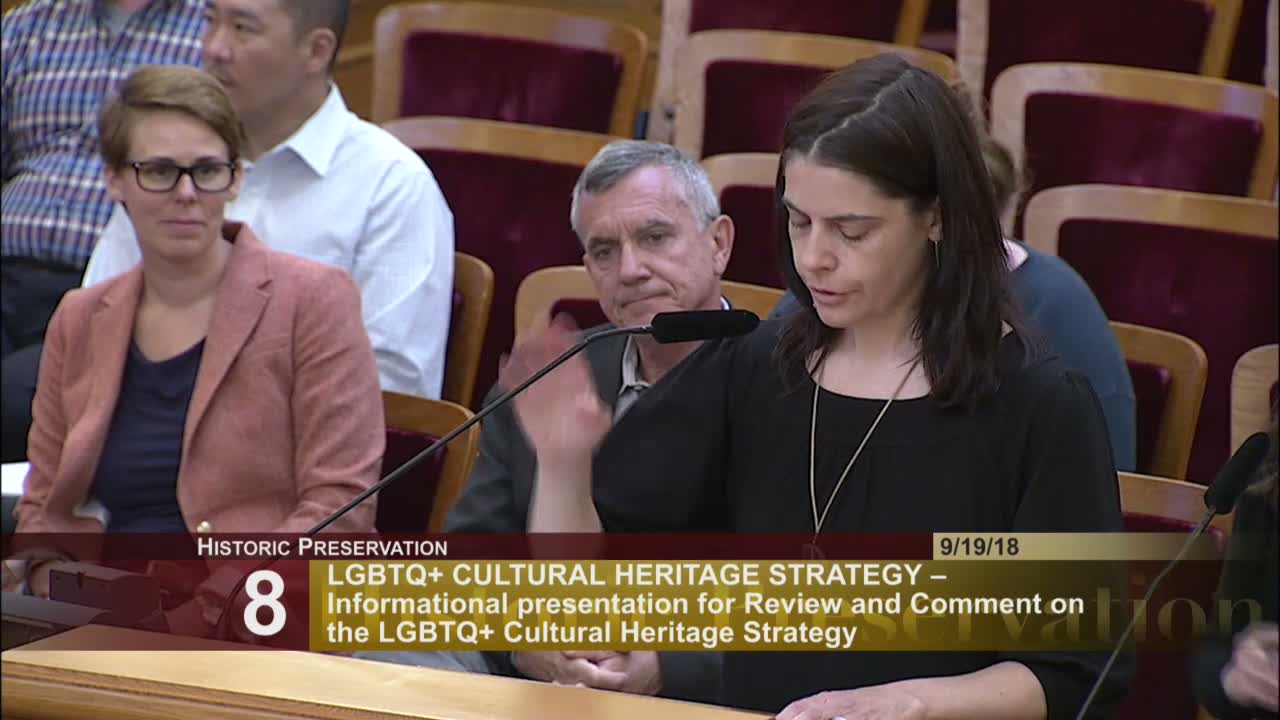
San Francisco — The Historic Preservation Commission on Sept. 12 reviewed a citywide LGBTQ cultural heritage strategy that would pair traditional preservation tools with new programs to sustain living community networks, and voted to endorse staff recommendations and continue work toward implementation.
Frances McMillan of the Planning Department told commissioners the strategy grew from a working group and broad outreach, including a quality-of-life survey that drew nearly 1,500 responses. The plan packages goals into committees focused on culture, well‑being and economic opportunity and recommends short-term actions such as creating a historic preservation advisory group to identify and protect LGBTQ historic sites and developing an online navigation tool to connect people to social services.
Shane Watson, co‑chair of the Arts, Culture and Heritage Committee, said the advisory group would let the community act “proactively about preserving LGBTQ historic sites and places as opposed to reactive.” Roberto Ordinana, deputy executive director of the SF LGBT Center, said the center “is in full support of this strategy” and emphasized that the plan seeks to protect vulnerable community members and expand economic opportunity through services, education and small‑business support.
Claire Farley, the mayor’s senior advisor on transgender initiatives, described her office as “the first and only trans‑led, city government office working to support communities” and said the office would collaborate on monitoring, advocacy and training tied to the strategy.
Public speakers, including representatives of the GLBT Historical Society and community members working in historic sites, urged commissioners to support the recommendations, stressing the role of places such as the Castro in providing historical context and community continuity.
Commissioners broadly praised the plan and asked staff for actionable performance measures and implementation details. Ideas raised included compiling oral histories of elders, creating a health‑care provider directory for people undergoing transition, a summit to launch the strategy and a commitment to nominate at least one LGBTQ‑related landmark or legacy business on an annual basis. Staff said it would continue to develop implementation plans, budgets and timelines and return with a draft strategy report for public comment and for eventual presentation to the Planning Commission and Board of Supervisors in early 2019.
What’s next: Staff will draft the strategy report, refine performance measures and plan additional outreach. The commission’s comments will be forwarded to the Planning Commission and Board of Supervisors as the city develops an implementation plan.