Get Full Government Meeting Transcripts, Videos, & Alerts Forever!
Get email alerts on the Public Toilets Kiosks topic
No spam. Unsubscribe anytime.
San Francisco commissions generally back modern redesign of public toilets and kiosks, urge material and maintenance safeguards
Summary
The Historic Preservation Commission and Arts Commission Civic Design Review Committee reviewed SmithGroup—s winning designs for replacing 25 public toilets and 114 kiosks; commissioners praised the sculptural approach but pressed for material samples, clearer plans for maintenance, limits on reflective finishes and caution about rooftop planting. (Aug. 15 return scheduled.)
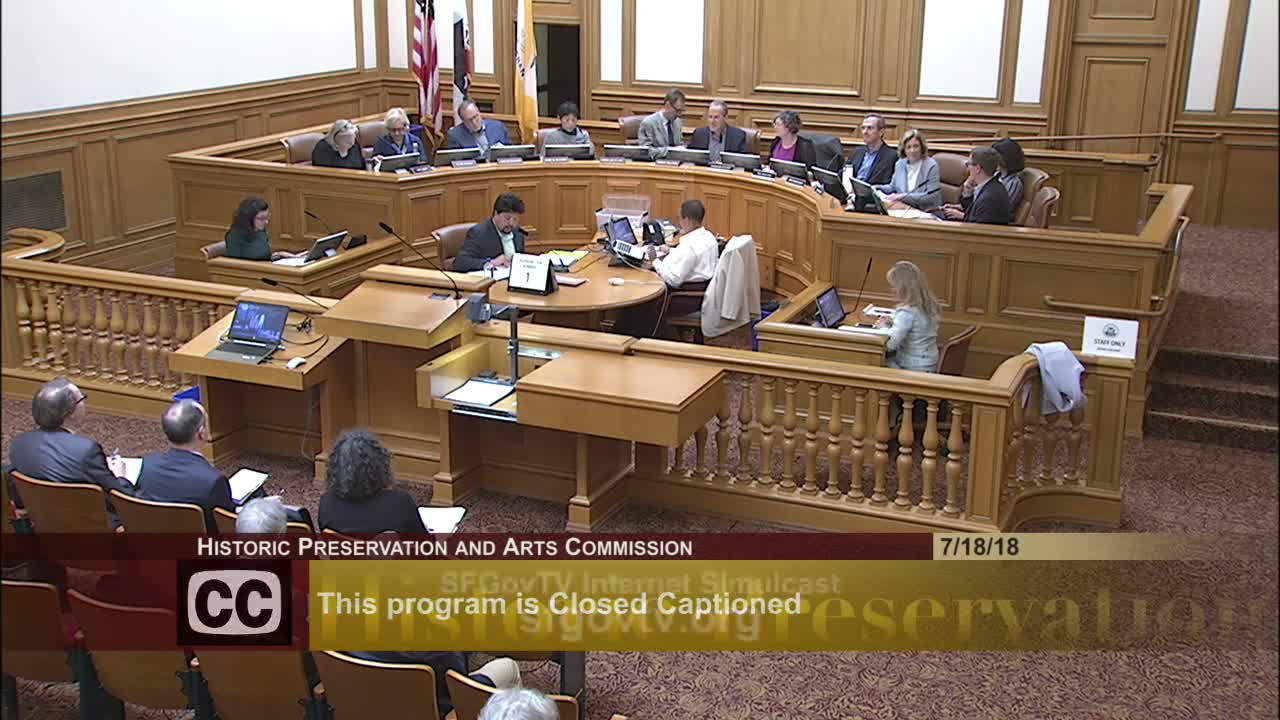
SAN FRANCISCO — The San Francisco Historic Preservation Commission met jointly with the Arts Commission Civic Design Review Committee on a special hearing to review a proposed citywide replacement of public toilets and street kiosks, a project led by San Francisco Public Works in partnership with JCDecaux and designed by SmithGroup.
Natalia Koyd Kowska, planning staff, told commissioners the project would remove and replace 25 public toilets and 114 kiosks citywide, including six toilets and 34 kiosks located in Article 10 and Article 11 landmark and landmark districts, and asked for advisory comments on compatibility with Secretary standards. Beth Rubinstein of San Francisco Public Works said the redesigned street furnishings grew out of an invitation-only design competition and more than 200 public responses gathered through an exhibition and online survey.
The commission—s discussion focused on three central issues: materials and durability, siting and engineering constraints, and programmatic elements such as interactivity and rooftop planting. Commissioners generally found the sculptural, contemporary proposal compatible with historic surroundings if treated as a clearly modern object rather than faux historicism, but asked the project team to return with material samples and more detail on maintenance and visual impacts.
"We could make them real amenities to the city," Rubinstein said, describing goals to treat toilets and kiosks as civic furnishings rather than background objects. Bill Cates of SmithGroup described a —kit of parts— approach to minimize exterior panel types for easier repair and replacement. SmithGroup also described conceptual features including skylights, planting options and a double‑stall toilet configuration being developed for high‑traffic sites.
Commissioners pressed JCDecaux on upkeep: Francois (JCDecaux) said the company staffs a seven‑day, two‑shift maintenance operation and noted, "we respond pretty fast" to graffiti and vandalism, citing spare parts and a long standing operations team. Commissioners urged the team to prioritize scratch‑resistant materials and to avoid shiny finishes that could cause sun glare or visual distortion in historic districts.
Debate about vegetation centered on feasibility and maintenance: SmithGroup presented the original —toilet trees— concept (a closed loop using hand‑wash water to irrigate rooftop planting), but staff and JCDecaux said full trees are likely infeasible at scale. Rubinstein said limited green‑roof demonstrations and treated rooftop surfaces are under consideration, with maintenance responsibilities split between JCDecaux and community benefit districts in some locations.
Staff clarified program and site approach: of the 114 kiosks, about 69 are traditional newsstand kiosks; the new contract would replace roughly 20 with micro‑business kiosks intended for small vendors or pop‑ups. Up to a dozen double‑stall toilets are under consideration for Civic Center Plaza, UN Plaza, Twin Peaks and port sites such as Jefferson near Fisherman—s Wharf. Foundations for toilets are approximately 18 inches below grade, the team said, so removal and replacement should not leave obvious surface scars.
Public comment urged caution and historic sensitivity. Stan Hayes of the Telegraph Hill Dwellers called the decision "a once in a generation decision" and urged the commission to consider designs that better evoke the city's history or to consider refurbishment where feasible. Staff responded that the existing kiosks and toilets have service‑life and interior mechanisms that make wholesale reuse impractical.
The project team will return to the Historic Preservation Commission for a certificate of appropriateness hearing and permits to alter, tentatively scheduled for Aug. 15; Civic Design Review Committee phase 2/3 review is planned for Aug. 20 and additional Arts Commission action will follow (Arts Commission next meets Oct. 1). Commissioners asked that the return package include material samples, refined kiosk options (including the preferred pillowed kiosk variant), and clearer plans for maintenance responsibilities and rooftop treatment.
The commissions offered generally supportive design feedback while setting clear requirements for further technical detail and sample materials before final approvals.