Get Full Government Meeting Transcripts, Videos, & Alerts Forever!
Get email alerts on the Cultural Districts topic
No spam. Unsubscribe anytime.
Historic Preservation Commission backs staff amendments to San Francisco cultural‑district ordinance
Summary
The Historic Preservation Commission on June 6 recommended approval of staff-suggested amendments to the recently enacted cultural‑district ordinance, urging stronger implementation guidance, community-led working groups, and clarified uses for a new Cultural District Fund; the commission’s resolution passed unanimously 5–0 and will go to the Board of Supervisors.
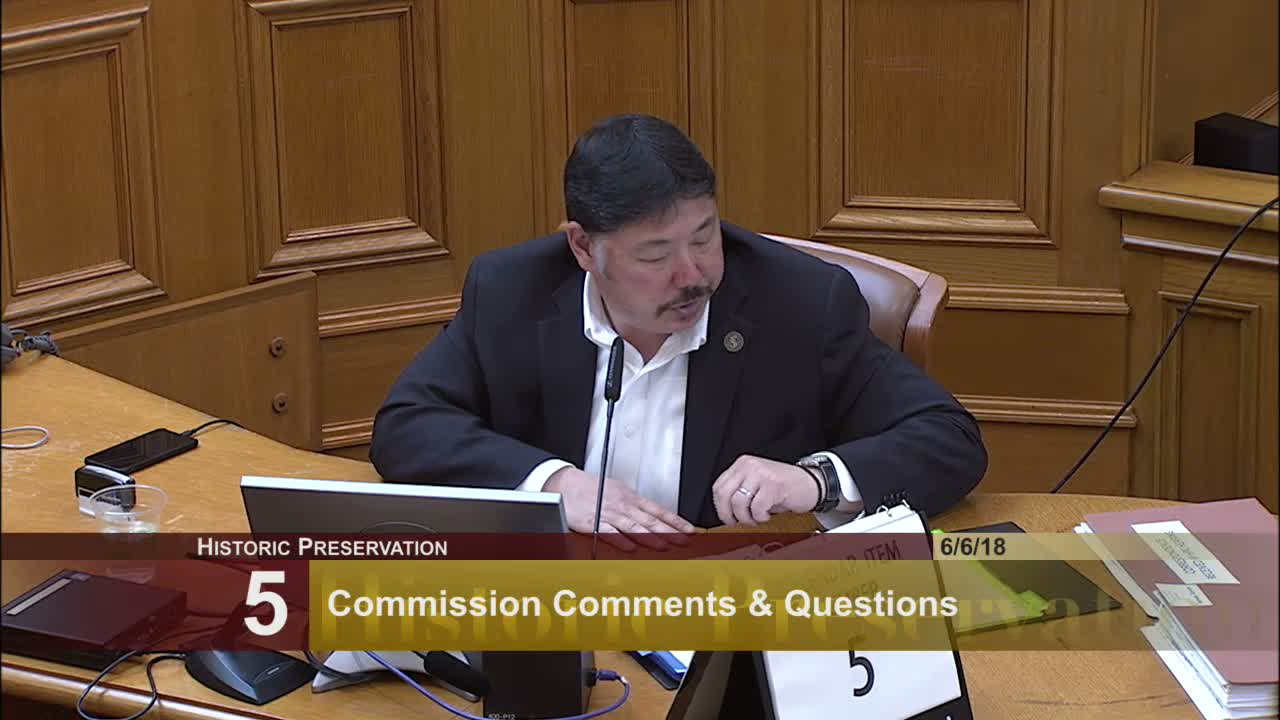
The San Francisco Historic Preservation Commission on June 6 voted unanimously to recommend approval of staff-recommended amendments to a newly enacted ordinance establishing cultural districts across the city.
The commission’s action follows presentations from city planning staff and the sponsor’s office, lengthy public comment from cultural‑district organizers and preservation groups, and detailed staff proposals to clarify how districts are defined and implemented. The resolution passed 5–0.
Carolina Morales, speaking on behalf of Supervisor Ronan, told the commission the ordinance creates an official recognition and a formalized process for cultural districts intended to protect culturally relevant businesses, arts and affordable housing and to provide a framework for city departments to invest in stabilization funds. “This legislation shapes cultural districts as community stabilization tools within neighborhoods,” Morales said.
Shelly Caltagironi, preservation staff, outlined staff recommendations that would: replace the word “unique” with “distinct” in the ordinance’s definition to allow groups with multiple geographic locations to qualify; remove the clause that limited eligibility to groups described as historically discriminated against while creating a priority process to recognize vulnerable communities; permit overlapping district boundaries; require community-led cultural district working groups during the application process; create an interdepartmental advisory group in MOHCD rather than a board‑appointed advisory committee; allow flexibility to extend early reporting deadlines tied to district strategies; and clarify permissible uses of the Cultural District Fund, including the ability to support housing projects near (but not necessarily inside) district boundaries and to explore linking fund uses to CEQA mitigations.
Public commenters largely praised the ordinance’s goals but urged caution about reopening recently passed legislation. Terry Bezwick of the GLBT Historical Society said the law is “badly needed” and warned that some amendments could be pursued administratively rather than by reopening the ordinance. Moises Garcia, a founder of the Cultural District Coalition, said the ordinance had just been signed and cautioned against changes that could slow community‑led processes. Honey Mahogany, district manager for the Compton’s Transgender Cultural District, said the ordinance is an important mitigation tool against displacement and urged preserving emphasis on the city’s most vulnerable communities.
Commissioners framed staff recommendations as experience‑driven improvements to implementation. Commissioner Johns and others said staff’s on‑the‑ground experience with Japantown and SoMA Filipinas informed practical suggestions for implementation and community outreach. Carolina Morales and planning staff said departments and the sponsor’s office had met on multiple drafts but the ordinance moved quickly through the Rules Committee once finalized; staff recommended clarifying implementation details during the program roll‑out.
The commission moved to adopt a resolution recommending approval of the ordinance with the modifications recommended by staff; the motion was seconded and passed unanimously 5–0. The commission’s recommendation will be forwarded as part of the city’s legislative record and is expected to inform final Board of Supervisors action and implementation planning.
Next steps: the commission’s resolution will be transmitted to the Board of Supervisors and implementation will proceed through the Mayor’s Office of Housing and Community Development and participating departments per the ordinance and subsequent administrative procedures.