Get Full Government Meeting Transcripts, Videos, & Alerts Forever!
Get email alerts on the Historic Landmark Initiation topic
No spam. Unsubscribe anytime.
Commission initiates landmark nomination for Arthur H. Coleman Medical Center in Bayview
Summary
The Historic Preservation Commission voted unanimously to initiate landmark designation for the Arthur H. Coleman Medical Center (6301 Third Street), citing Dr. Coleman’s decades of community medical service and the building’s integrity; commissioners asked staff to work with community members on an interpretive plaque and legacy materials.
The San Francisco Historic Preservation Commission unanimously voted April 18 to initiate local landmark designation for the Arthur H. Coleman Medical Center at 6301 Third Street in the Bayview Hunters Point neighborhood.
Desiree Smith, department staff, presented a draft nomination describing the building’s period of significance (1960–2002), its association with Dr. Arthur H. Coleman—an African‑American physician, lawyer and community leader—and the building’s retention of exterior and interior features such as stucco cladding, porcelain‑enameled steel panels and a historic recessed pharmacy entrance. Staff said the property was eligible under the commission’s priorities to recognize modern design, underrepresented geographies and strong cultural or ethnic associations, and recommended initiating designation and continued documentation prior to a final draft report.
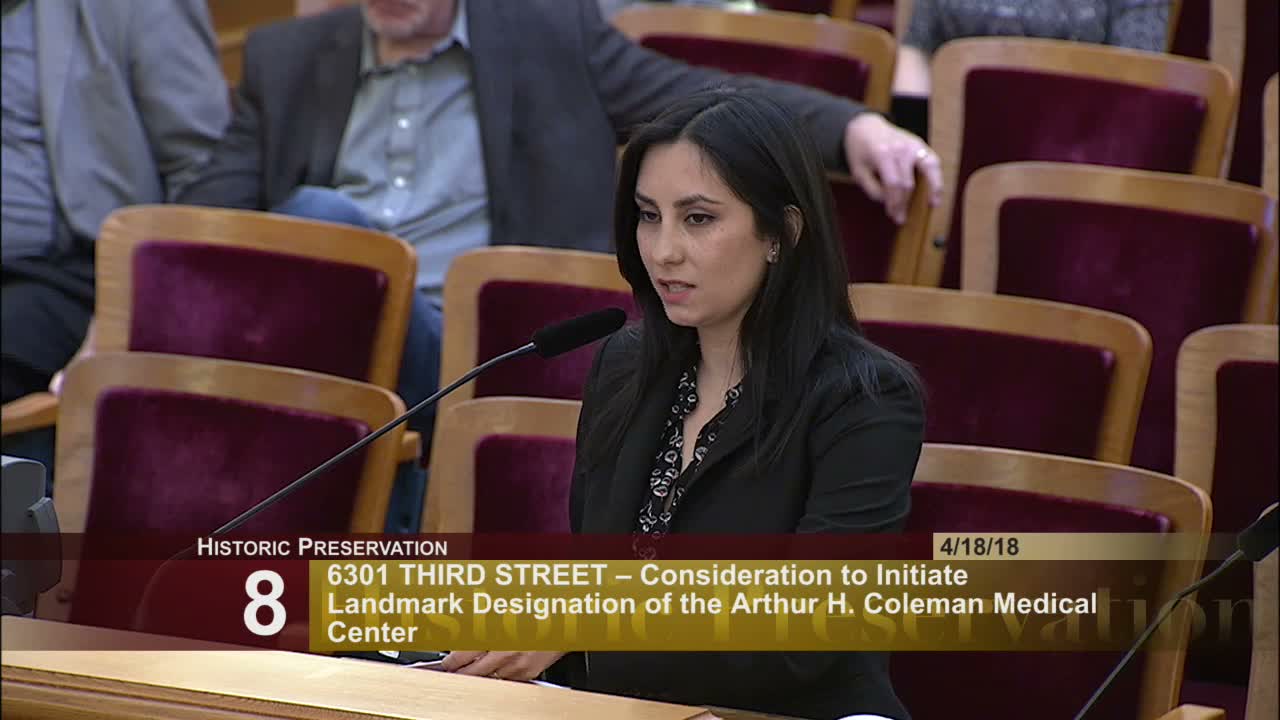
Several community members spoke in support. Pat Coleman, Dr. Coleman’s daughter, told the commission her father provided decades of care—sometimes free—and urged preservation to keep the building as a “beacon of hope.” Javon Muhammad, CEO of a community clinic, and ministers and neighborhood residents described the building as an important cultural landmark and requested that the nomination consider interpretive materials to tell Dr. Coleman’s story. One commenter said the neighborhood’s African‑American population is now “less than 5%,” a point made to underscore local cultural preservation needs.
Commissioners praised the nomination and recommended staff work with community members on supplemental interpretive materials, such as a plaque or interior mural, to convey the building’s social history. The commission moved and voted to initiate the designation and to request that staff coordinate with community members on legacy/interpretive materials; the motion passed 7‑0.
Staff said a final draft of the nomination, with additional photographs and a floor plan indicating interior spaces proposed for protection, will be presented at the commission’s next hearing.