Get Full Government Meeting Transcripts, Videos, & Alerts Forever!
Get email alerts on the Historic Resource Evaluation topic
No spam. Unsubscribe anytime.
Planning staff says demolition of 150 Eureka Street is a significant CEQA impact; commission seeks clearer mitigation steps
Summary
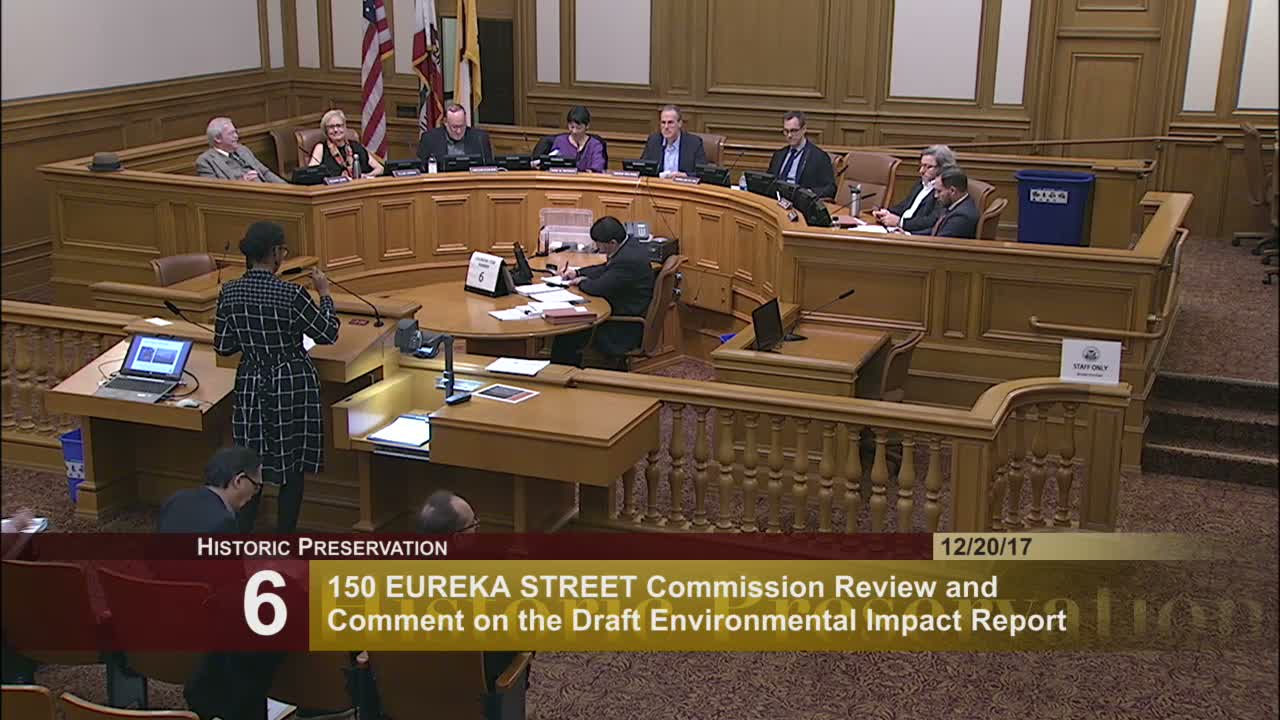
Planning staff told the Historic Preservation Commission the draft EIR for 150 Eureka Street finds demolition of the former Metropolitan Community Church would be a significant and unavoidable impact; commissioners supported the EIR findings but asked staff to provide practical, enforceable mitigation steps (HABS documentation, plaque or walking-tour implementation) before project permits proceed.
Jenny Delumo, environmental planner for the project, presented the draft Environmental Impact Report (EIR) for 150 Eureka Street, explaining that the circa-1909 building (formerly the Metropolitan Community Church) is identified as a historical resource under CEQA. "The draft EIR concluded that the demolition of the building would result in a substantial adverse change to the significance of the historical architectural resource and would therefore result in a project level significant and unavoidable impact," Delumo told the commission.
The draft EIR includes two mitigation measures intended to reduce but not eliminate the impact: (1) Historic American Buildings Survey (HABS) documentation of the structure and (2) development of an interpretive program that could include a publicly accessible walking tour and an identifying plaque system. The EIR also analyzes a no-project, full-preservation and partial-preservation alternative.
Commissioners raised practical questions about how a walking tour or plaque program would be implemented for a four-unit infill project and who would be responsible for long-term administration. Commissioner Hyland said the building "has really no integrity left" in places but acknowledged the EIR consultants found it qualifies as a historic resource; other commissioners urged precision about who would be responsible for mitigation over time and whether a sidewalk or wall plaque would be a more reliable mitigation for this site.
David Silverman, representing the project sponsor, asked for specific guidance: "I'd be interested in hearing from the commission as to how you would interpret the appropriate scope of a walking tour for a 4 unit building." Planning staff said the mitigation monitoring and reporting program (MMRP) can identify responsible parties and that staff would add clarification in the response-to-comments. Commissioners agreed to write a letter stating they concur with the draft EIR's findings while urging staff to provide clear, implementable directions to the sponsor on how to satisfy the interpretive mitigation before final permits are issued.