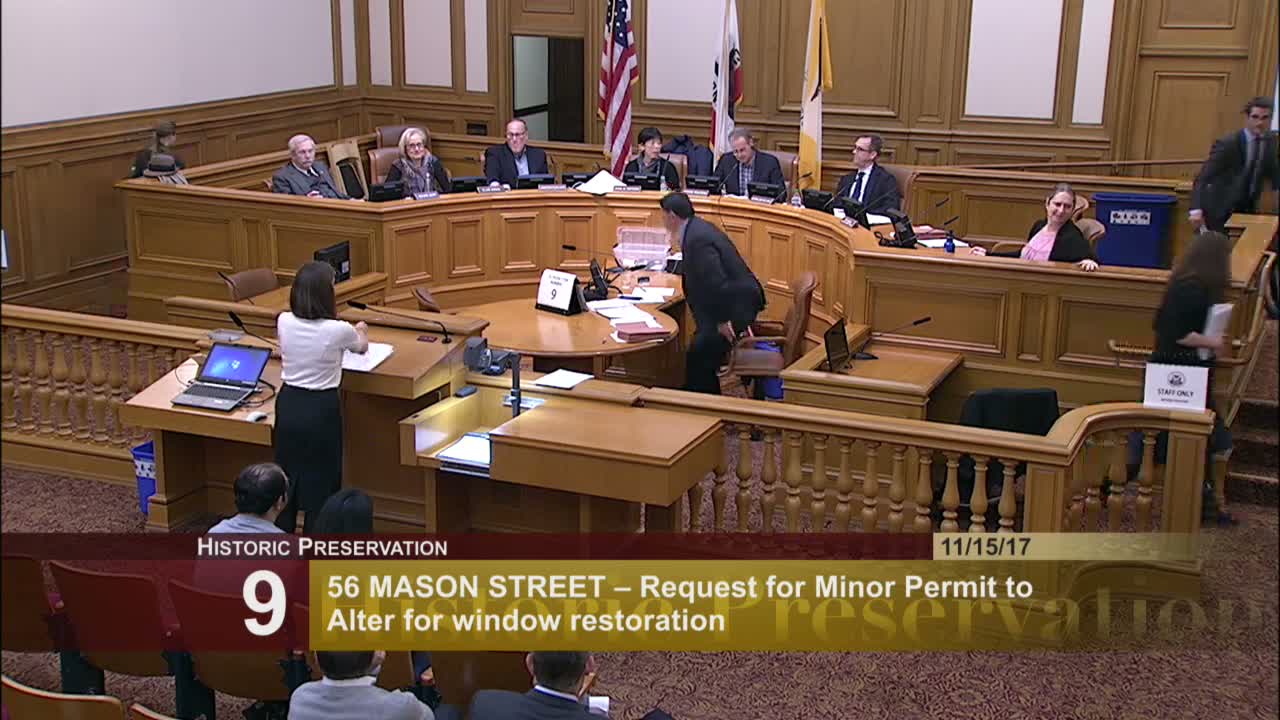
Community urges halt to Bristol Hotel work as commission approves window restoration
Loading...
Summary
After hours of public comment alleging tenant displacement and illegal evictions at the Bristol Hotel (56 Mason St.), the Historic Preservation Commission approved a permit to alter for window restoration while commissioners said other enforcement and housing questions lie with courts, DBI and the Planning Commission.
The Historic Preservation Commission approved a permit to alter for window restoration at 56 Mason Street — the Bristol Hotel — after more than an hour of public testimony alleging the building’s owner evicted low‑income tenants and is converting Single‑Room Occupancy (SRO) units toward tourist use.
Planning Department staff said the project proposes restoration and replacement of upper‑floor windows and a new storefront, and recommended approval with conditions to ensure work meets Article 11 and Secretary of the Interior standards. Staff noted the building contains 41 legal SRO units and 16 tourist rooms and said court documents and a receivership order were included in the commission packet.
Speakers representing tenant‑advocacy groups and former residents urged the commission to halt the permit or send the matter to a body with broader authority. Sue Hesser, who said she forced a hearing and cited a court decision (Jaramillo v. Balwalt and Tekor), told commissioners the developer had evicted tenants and marketed the building as a tourist hotel. Alexandra Goldman of the Tenderloin Neighborhood Development Corporation said upgrades to SROs have repeatedly led to displacement of low‑income tenants in the Tenderloin. Joe Wilson of Hospitality House described the project as “egregious” and urged denial, saying the matter belongs before the Planning Commission and in court.
Other speakers, including tenant‑service providers and formerly housed residents, described the human impact of displacement and urged that any approval not further delay returning habitable SRO units to low‑income tenants. Several asked staff and the commission to forward the public record and concerns to the Planning Commission and other city officials.
Commissioners cautioned that the Historic Preservation Commission’s jurisdiction is narrow. Commissioners noted staff’s findings that the proposed window work is consistent with historic‑preservation standards and that other enforcement or land‑use questions (SRO unit removal, conditional use authorization) fall to the Department of Building Inspection and the Planning Commission or the courts. Several commissioners said they did not want to delay rehabilitation that could make units re‑occupiable sooner. The commission voted to approve the permit with the conditions recommended by staff and directed staff, through the chair, to convey public concerns to the Planning Commission, the Board of Supervisors and the mayor’s office for follow‑up.
The commission’s approval allows staff to require the specified mock‑ups and conditions be met prior to issuance of a site permit; it does not itself change or remove the building’s existing SRO unit count or resolve outstanding litigation. Staff also noted a special master/receiver is overseeing the construction timeline spelled out in the court documents included in the record. The parties and agencies responsible for enforcing tenant‑protection or eviction claims were identified during the hearing as DBI, the Planning Department and the courts.