Get Full Government Meeting Transcripts, Videos, & Alerts Forever!
Get email alerts on the India Basin Project topic
No spam. Unsubscribe anytime.
Draft EIR says India Basin mixed‑use plan would harm cultural landscape; preservation alternatives proposed
Summary
Planning staff told the Historic Preservation Commission that the draft environmental impact report for the India Basin Mixed‑Use Project finds significant, unavoidable impacts to the India Basin cultural landscape unless full or partial preservation measures are implemented; the Planning Commission will accept written comments through Oct. 30 and hold a public hearing Oct. 19, 2017.
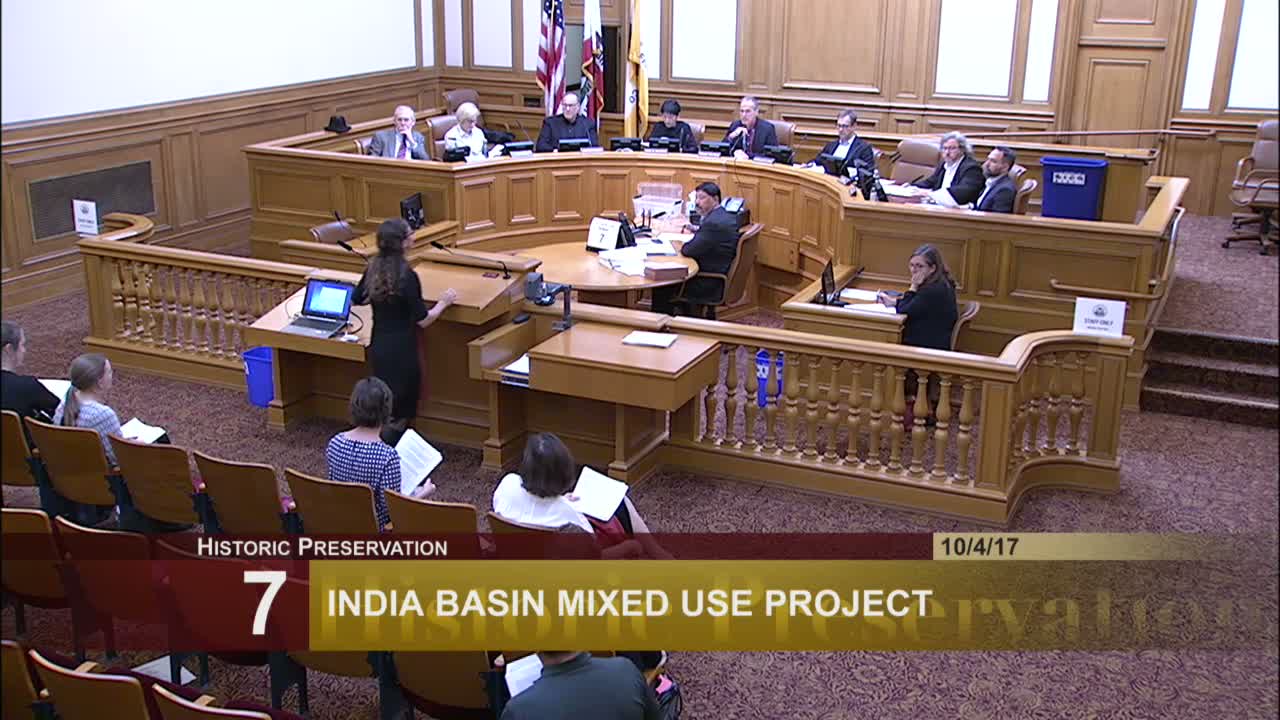
Planning staff and project proponents briefed the Historic Preservation Commission on the India Basin Mixed‑Use Project and the draft environmental impact report (EIR), which finds that the proposal would cause substantial changes to the site’s historic boatyard landscape and that some impacts are "significant and unavoidable." Allison Van der Sluis, planning department staff, opened the session and described the EIR findings and the preservation alternatives under consideration.
Phil Ginsberg, general manager of the Recreation and Park Department, framed the project as a major park investment for San Francisco and the Bayview community, saying the park component "is the most important park development project that this city has tackled in its modern history." He and department staff emphasized the project’s equity goals and described efforts to preserve key features of the site’s maritime history.
Courtney Pash, senior project manager at BUILD Inc., described the private mixed‑use program and site plan. BUILD’s presentation noted roughly 1,240 new mixed‑income residential units, approximately 275,000 square feet of commercial space, up to 1,800 below‑grade parking spaces, and an 11‑acre park. Pash said BUILD coordinated a multi‑year community process and intends the development to integrate with three adjacent park parcels and the city’s India Basin Waterfront Parks and Trails plan.
Planning staff summarized the EIR’s historic‑resource analysis: the document identifies three principal historic resources in the project area — the 702 Earl Boatyard Building, the Shipwright’s Cottage (a San Francisco City landmark), and the India Basin scow‑schooner boatyard vernacular cultural landscape. The draft EIR concluded the proposed project would "result in significant and unavoidable impacts" to the India Basin cultural landscape because of the proposed demolition or removal of two of the three buildings that help define the landscape and because of other changes such as regrading, new paths and plantings.
Staff described five mitigation measures intended to reduce harm: development and implementation of preservation and rehabilitation plans; Historic American Building/Landscape documentation (measured drawings, photography and reports); a permanent program of interpretive displays about boatbuilding history on the site; retention by Recreation and Park of the Boatyard Office building by RPD where feasible; and a vibration protection plan during construction. Planning staff said mitigation could reduce impacts to the 702 Earl and the Shipwright’s Cottage to less than significant, but even with mitigation the cultural landscape at 900 Innis would likely remain significantly affected unless the full preservation alternative is adopted.
The draft EIR therefore presents two preservation alternatives: a full preservation alternative that rehabilitates all three significant buildings to Secretary of the Interior standards, and a partial preservation alternative that retains all or part of the boatyard office building while interpreting the tool‑shed and water tank. Planning staff said both alternatives could reduce the historic‑resource impact to less than significant with mitigation, but feasibility and funding remain uncertain.
Commissioners asked technical and procedural questions: whether the Arts Commission or city attorney had provided legal precedents, which agencies had been consulted (BCDC, the Design Review Board, the Regional Water Quality Control Board, Army Corps and the San Francisco Department of Public Health were named), and what documentation standards the project will follow. Staff said Historic American Building/Landscape surveys are included in mitigation and that the EIR takes a conservative approach because retention of the buildings remains uncertain.
The commission agreed to draft comments on the EIR. Planning staff noted the Planning Commission public hearing on the draft EIR is scheduled for Oct. 19, 2017 and that written comments will be accepted through 5 p.m. on Oct. 30, 2017. The Historic Preservation Commission’s comments will be used to assist the Planning Commission in preparing its letter on the draft EIR.
What’s next: Commissioners instructed staff to prepare an HPC comment letter for the draft EIR and to circulate Arts Commission materials and additional documentation for the Pioneer Monument and India Basin items in advance of future hearings.