Get Full Government Meeting Transcripts, Videos, & Alerts Forever!
Get email alerts on the Historic Preservation topic
No spam. Unsubscribe anytime.
Draft EIR finds demolition of 450 O'Farrell would cause significant unavoidable historic impacts, commissioners request clearer objectives
Summary
Planning staff told the Historic Preservation Commission that the draft EIR for the 450–474 O'Farrell/532 Jones project concludes demolition of the Fifth Church building would be a significant and unavoidable historic-resource impact; commissioners and preservation advocates urged clearer, quantifiable project objectives and asked staff to draft formal comments to the Planning Department.
Planning Department staff told the Historic Preservation Commission on Nov. 1 that the draft environmental impact report for a proposed mixed-use project at 450–474 O'Farrell Street and 532 Jones Street would require demolition of the church at 450 O'Farrell and that the loss would be a significant and unavoidable impact to a historic resource.
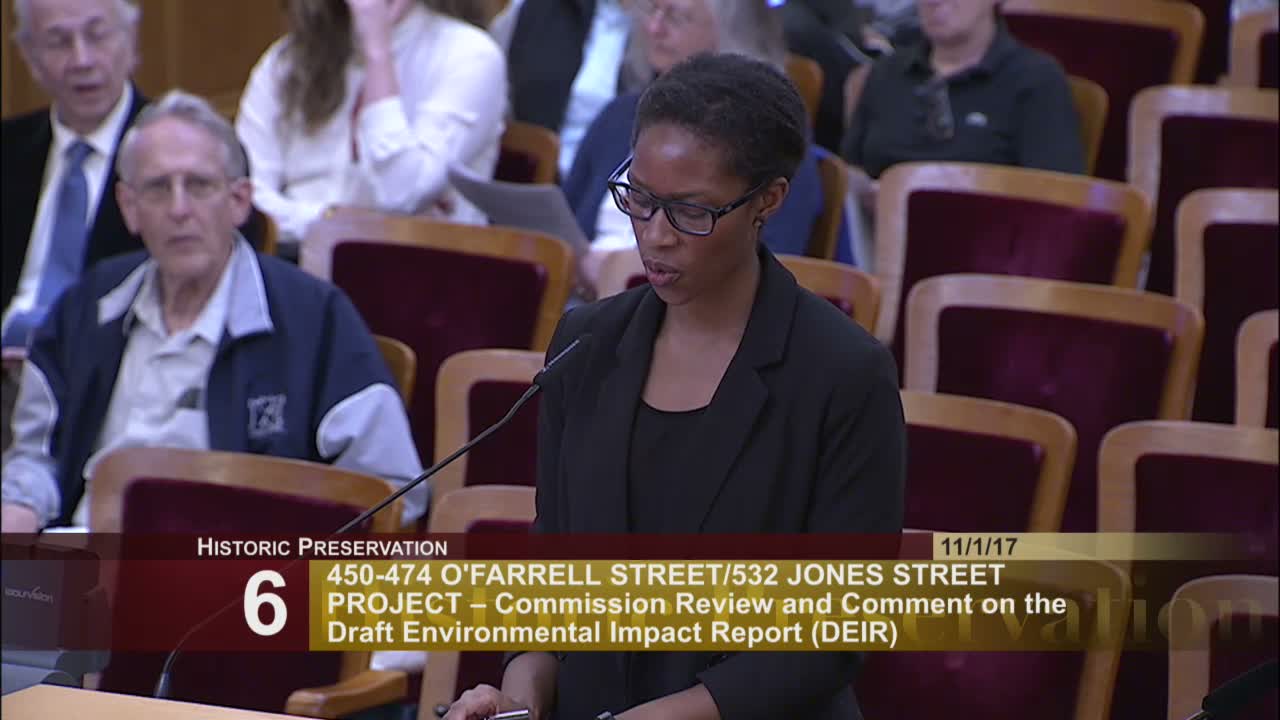
"The draft EIR concluded that the proposed project would result in a substantial adverse change on the significance of the historic resource at 450 O'Farrell Street," Jenny Delumo, the department's EIR coordinator for the project, said in summary. The proposed project described in the draft EIR would construct an approximately 238,000-square-foot, 13‑story building with up to 176 dwelling units, about 6,200 square feet of retail, a 14,000-square-foot replacement church and roughly 21,000 square feet of below-grade parking.
Delumo said staff identified three mitigation measures intended to reduce the historic impact: preparation of a Historic American Buildings Survey (HABS) and video documentation, installation of permanent interpretive display materials about the building and the Uptown Tenderloin historic district, and preparation of a salvage report prepared by a professional meeting Secretary of the Interior standards. "While these mitigation measures would reduce the impact," Delumo said, "the proposed demolition would remain significant and unavoidable."
Preservation groups and neighborhood speakers told the commission the draft EIR understated preservation options and that the project's stated objectives were vague. "One of the project objectives is to construct well‑designed, financially feasible mixed‑use residential housing units, but there is no definition of financially feasible," Mike Bueller of San Francisco Heritage said. Bueller and Courtney Dampkroger, also speaking for Heritage, urged the commission to press for quantifiable objectives and to consider transfer of development rights and other measures to make full preservation more feasible.
Project representatives said the Fifth Church of Christ, Scientist has been considering a redevelopment for decades and that the congregation seeks a modernized facility with a reading room required by its charter. "The partial demolition of this building already is considered a compromise," David Sincotta, representing the project sponsor, said. He also said the sponsors will provide an economic analysis comparing preservation alternatives to the proposed project.
Commissioners debated whether the draft EIR's three alternatives (no project, full preservation, partial preservation) were analyzed adequately. Several commissioners said the EIR's language about whether preservation alternatives meet the project's qualitative objectives (for example, creating "vibrant" public spaces) is subjective and should be clarified. The commission agreed to have staff draft a letter for the commission that would concur in the EIR's technical conclusions about alternatives while calling on the Planning Department and project sponsor to provide clearer, quantifiable project objectives and additional economic analysis to inform preservation feasiblity.
Administrative next steps noted in staff materials include a Planning Commission hearing on the draft EIR scheduled for Nov. 30 and a written comment deadline of 5 p.m. on Dec. 11. Staff anticipated publication of a comments-and-responses document in spring 2018 followed by an EIR certification hearing in late spring 2018.
The commission's action: direct staff to prepare a comment letter identifying concerns about subjective project objectives and endorsing the need for more specificity and supporting analysis; no formal policy change or vote on preservation was taken on Nov. 1.