Get Full Government Meeting Transcripts, Videos, & Alerts Forever!
Get email alerts on the Van Ness Brt topic
No spam. Unsubscribe anytime.
Historic poles, modern design and delays: commission backs simplified shelters and replacement approach for four Van Ness poles
Summary
After months of discussion and public comment, the commission approved a simplified shelter design for the Van Ness McAllister BRT station and recommended fabricating new concrete poles while salvaging historic cast-iron elements for four trolley poles near Civic Center; commissioners expressed mixed views about broader replication of historic poles across the corridor.
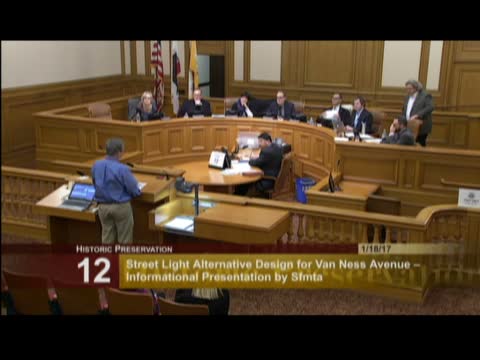
SFMTA project lead Peter Gavancho presented three options for streetlight and trolley poles for the Van Ness Bus Rapid Transit (BRT) project: the previously approved modern OCS pole, a hybrid historic design with a straight arm, and a hybrid historic design with a curved arm. Gavancho said the Board of Supervisors had asked the SFMTA to explore preserving or replicating historic poles where feasible and noted the alternatives vary in cost, height and appearance and would require approvals from the Arts Commission and the Historic Preservation Commission.
The commission heard extensive public comment. Preservation groups and neighborhood coalitions urged retention or replication of historic elements, citing the poles's connection to the 1936 Golden Gate Bridge lighting and the corridor's Beaux-Arts character. Several residents and transit advocates warned that changing the approved modern design could delay construction, increase costs and prolong two-plus years of disruption along the corridor.
On the Macallister Station certificate-of-appropriateness item, staff presented revised shelter designs and an Architectural Resources Group (ARG) conservator memo evaluating four concrete trolley poles in front of City Hall and the War Memorial Court. ARG outlined three feasible treatments: in-situ cosmetic repair, selective replacement with repair, or fabrication of new concrete poles while salvaging and reinstalling cast-iron finials, brackets, luminaires and bases. Staff recommended the simplified, visually transparent shelter design for the McAllister station and recommended Option 3 for the four trolley poles as the most durable long-term treatment that allows salvage of historic cast-iron elements without imposing excessive ongoing maintenance.
Commissioners weighed preservation values against cost, constructability and long-term maintenance. While some members criticized replication as "false historicism," others supported retaining the salvaged cast-iron elements and fabricating new concrete poles to ensure structural safety and reduced maintenance burdens. The commission approved staff recommendations, including conditions requiring conservator oversight, mockups, documentation, and a maintenance program, by unanimous vote.
Next steps: The project sponsor and conservator will coordinate removal, documentation, restoration and reinstallation of cast-iron elements, and planning staff will review treatment mockups and specifications prior to full-scale restoration or replacement.