Get Full Government Meeting Transcripts, Videos, & Alerts Forever!
Get email alerts on the Mission Murals Inventory topic
No spam. Unsubscribe anytime.
Intern presents Mission Murals inventory documenting 500+ murals to aid planners
Summary
A planning‑department intern presented a Mission Murals Inventory and GIS layer documenting more than 500 community murals, a tool staff said will help planners flag cultural resources during project review and respond to gentrification pressures.
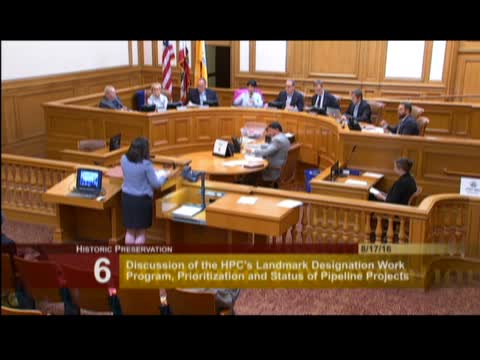
Lindy Secrest, a planning‑department intern, told the San Francisco Historic Preservation Commission on Aug. 17 that her Mission Murals Inventory documents over 500 murals, includes mural metadata and a GIS layer, and is intended as a tool for planners to flag properties that host culturally significant murals.
"My internship project this summer was to create an inventory of Mission murals to aid in the preservation of historically and culturally significant murals," Secrest said, describing the inventory, the GIS layer and a methodology informed by interviews with artists and community organizations. She explained the inventory classifies murals as legacy, contemporary or temporary and noted that ownership change is one of the greatest threats to murals; she cited an example in which a legacy mural by veteran artist Juana Alicia was painted over.
Why it matters: the Mission District contains one of the largest concentrations of community murals in San Francisco and murals are integral to local cultural expression. Staff said the GIS layer and resulting property flags will allow planners to identify mural sites early in project review so historic‑resource evaluations can be requested where appropriate.
Secrest described the survey methodology (field surveys, archival research, interviews with muralists and community organizations such as Precita Eyes and the Mission Cultural Center), and said the inventory records titles, artists, completion dates and background information. She said the tool has already helped staff provide timely feedback on a project this summer and that final presentations and data access would be posted to the department’s website; interns are scheduled to finish on Aug. 26.
What’s next: commissioners asked how to obtain the inventory and staff said the presentation and dataset will be posted on the Planning Department website and distributed to commissioners. The item was informational and no formal action was taken.