Get Full Government Meeting Transcripts, Videos, & Alerts Forever!
Get email alerts on the Legacy Business Registry topic
No spam. Unsubscribe anytime.
Historic Preservation Commission and Small Business staff map streamlined review for Legacy Business Registry
Summary
Following voter approval of Proposition J, the commission and Small Business staff discussed how the Historic Preservation Commission will review nominations for the Legacy Business Registry and suggested an immediate‑review model with a short staff checklist and consent calendar handling for positive recommendations.
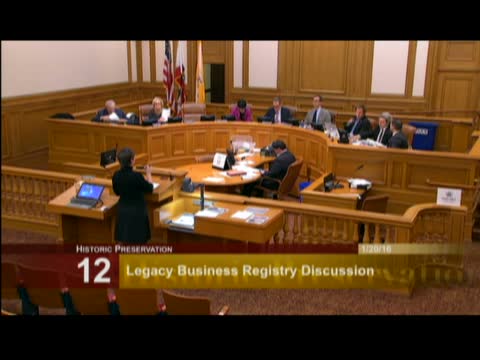
The Historic Preservation Commission spent an extended portion of its hearing working through implementation details for the newly enacted Legacy Business Registry and the Legacy Business Historic Preservation Fund (Proposition J). Regina Dickentriese (Director, Office of Small Business) summarized the nomination and application process: nominations are submitted by a supervisor or the mayor, the registry will accept up to 300 businesses per year, and applicants must establish eligibility based on longevity, contribution to neighborhood identity, and commitment to maintaining physical features or traditions.
Dickentriese said her office has received early inquiries and one nomination so far and emphasized limited initial staffing and the plan to rely on technical assistance from the Small Business Development Center to help businesses prepare application narratives. She explained the application sections, including contact information, a narrative addressing three eligibility criteria, archival or ephemeral material and confirmations about licensing, taxes and labor compliance.
Planning staff and commissioners discussed four procedural options for the HPC’s review role. City Attorney Victoria Wong advised that the ordinance requires an advisory recommendation from the HPC and that the HPC cannot fully delegate that advisory function to staff or a committee. After debate commissioners generally preferred an ‘‘Option 2’’ hybrid: the Small Business Commission would refer nominations immediately; planning staff would prepare a brief, checklist‑style case memo; nominations receiving a positive staff recommendation would be placed on the HPC consent calendar for formal action (removable if any commissioner requests discussion); nominations with questions or negative recommendations would be scheduled for a full HPC hearing. Supervisors’ aides and heritage advocates recommended this approach as a pragmatic balance that reduces burden on businesses and HPC staff without abrogating the commission’s responsibility.
Commissioners gave specific direction: remove financial‑viability screening questions (items K and L) from the HPC checklist because assessing a business’s full financials is outside the HPC’s preservation role; prioritize the applicant narrative and documented historic contribution; track staff time spent per application to measure workload; and prepare a sample case memo and staff template for commission review. Planning staff and Small Business Office agreed to provide a sample case report and to work with the HPC to set an operational cadence (monthly/quarterly batches for non‑urgent nominations while preserving immediate review for at‑risk businesses). Several commissioner comments underscored a preference to prioritize businesses (not landlords) in any fund allocations and to broaden character‑defining features beyond physical fabric to include cultural practices and community significance.
The HPC did not take a formal motion on the rules at this hearing (the item was review and comment) but provided detailed direction to staff that will be incorporated into draft administrative rules and staff templates for future hearings. The Small Business Office and Planning Department will continue to coordinate and return with sample reports and refined procedures.