Get Full Government Meeting Transcripts, Videos, & Alerts Forever!
Get email alerts on the Public Space Activation topic
No spam. Unsubscribe anytime.
Commission approves temporary Living Innovation Zone at United Nations Plaza
Summary
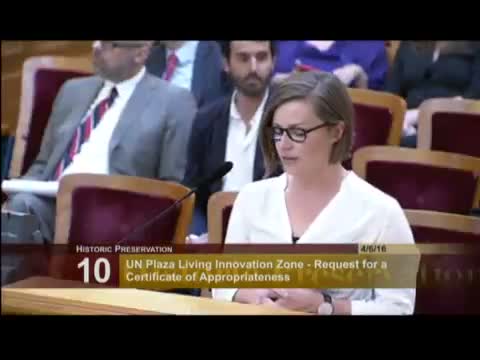
The Historic Preservation Commission on April 6 approved a temporary Living Innovation Zone (LIZ) in UN Plaza — a wooden-pathway public installation by the Exploratorium intended to activate the plaza for two to three years — with conditions on design details and permits.
The San Francisco Historic Preservation Commission on April 6 approved a proposal to install a temporary Living Innovation Zone in United Nations Plaza, endorsing staff recommendations that would allow wooden pathways and interactive acoustic elements to be installed for two to three years.
Cassie Hobert, program coordinator for the Planning Department's Living Innovation Zone program, told commissioners the UN Plaza installation is intended to activate public space with wooden pathways sited in raised planters and hands-on acoustic features such as chimes and xylophones. Hobert said the project has gone through community outreach, was reviewed by the Architectural Review Committee, and that the Mayor’s Office on Disability had reviewed an initial ADA submittal; Recreation and Parks is the permitting authority.
Josh Bascagalupi (Exploratorium Studio for Public Spaces) said the design was intended to invite diverse users and not to “disinvite any population.” He noted coordination with community stakeholders and offered additional color studies and ADA detail for commissioners to add to the project packet.
Supporters and staff emphasized mitigation and operational steps: Hobert outlined a maintenance and stewardship plan being finalized with Public Works and the Mayor’s Office of Economic and Workforce Development; staff recommended conditions requiring later review and approval of final design details, materials and finishes as part of the building-permit process.
Commissioners pressed for clear ADA documentation and close coordination with the farmers market that uses the plaza. Commissioner Permian and others praised the improved illustrations and ADA resolutions presented by staff and the project sponsor.
Commissioner (transcript speaker 12) moved to approve the certificate of appropriateness and to support staff recommendation; the motion was seconded and passed unanimously 7–0. The commission’s approval included the staff conditions that final design details and permitting be reviewed by the permitting authority before installation.