Get Full Government Meeting Transcripts, Videos, & Alerts Forever!
Get email alerts on the City Budget topic
No spam. Unsubscribe anytime.
Historic Preservation Commission unanimously recommends Planning Department budget, cites $5 million surplus
Summary
The commission voted 6–0 Feb. 3 to recommend approval of the Planning Department's proposed FY2016–18 budget and work program, highlighting a roughly $5 million fee revenue surplus, proposed new preservation and legacy-business staff, and one-time IT and preservation investments.
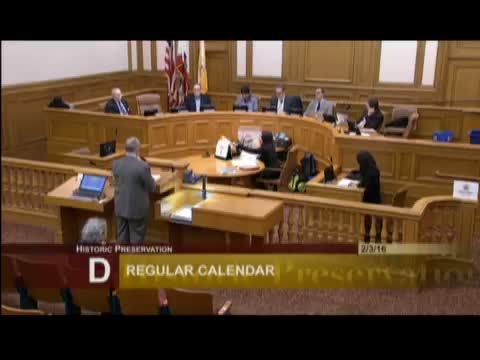
The San Francisco Historic Preservation Commission on Feb. 3 unanimously recommended that the Planning Department's proposed fiscal 2016–18 budget and work program be approved by the Planning Commission.
The commission voted 6–0 to forward a favorable recommendation after staff presented revenue and staffing projections. John Grama, Planning Department staff, told the commission the department was "seeing close to a $5,000,000 surplus this year" and proposed using part of that revenue to add a legacy-business staff position. Tom DeSanto, who led the budget presentation, said the department is projecting continued permit-volume growth and higher fee revenue next year.
Why it matters: the recommended budget would fund preservation-specific work and expand staffing to address permit backlogs and preservation tasks. DeSanto said the department expects fee revenue to rise toward $42 million next year and outlined proposed uses including digitization and one-time IT investments to expand electronic storage.
Key details: staff said about 70 percent of the department's budget is salaries and fringe. Preservation-specific increases in the proposed budget include $150,000 for an Article 10 plaque program, $35,000 expected from the Office of Historic Preservation grant program, and $50,000 proposed for hearing transcription services. The department proposed 14 new positions in 2016–17 (annualizing to 19 in 2017–18) across current planning, policy initiatives (including a legacy-business planner), process improvements and community outreach; one preservation planner position at the planning information counter was also proposed.
Performance measures and timeline: DeSanto said the department plans to shift to broader program-level performance measures (a 'scorecard' approach) rather than narrowly counting processing time for individual permit types. Staff said the budget would go to the Planning Commission for review on Feb. 4 and the mayor would submit a proposed budget to the Board of Supervisors by June 1.
Votes at a glance: The commission adopted two formal, recorded motions during the meeting: adoption of draft minutes for Jan. 20, 2016 (approved 6–0) and recommendation that the Planning Department's FY2016–18 budget and work program be considered favorably by the Planning Commission (approved 6–0).
What comes next: the Planning Department will present the budget to the Planning Commission; the mayor's office will receive department budgets on Feb. 22 and is scheduled to submit the city budget to the Board of Supervisors on June 1.