Get Full Government Meeting Transcripts, Videos, & Alerts Forever!
Get email alerts on the Cultural Heritage topic
No spam. Unsubscribe anytime.
Commission adopts citywide LGBTQ historic context statement after broad community outreach
Summary
The Historic Preservation Commission unanimously adopted a comprehensive LGBTQ historic context statement documenting San Francisco’s LGBTQ history from early influences through the AIDS crisis; authors and community groups praised the research and recommended the statement be used for future resource surveys and landmark nominations.
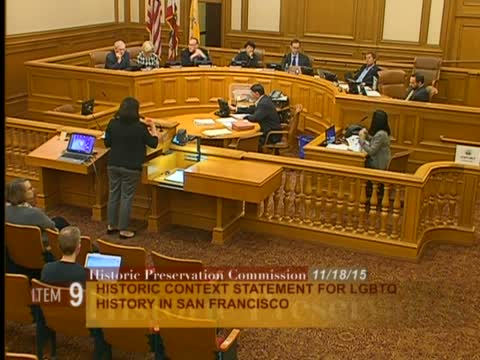
The Historic Preservation Commission unanimously adopted a citywide Lesbian, Gay, Bisexual, Transgender and Queer historic context statement on Nov. 18, endorsing a multi‑year research project the department commissioned to document places, themes and evaluation frameworks for LGBTQ historic resources in San Francisco.
Susan Parks of the Planning Department introduced the report, explaining that consultants Donna Graves and Shane Watson conducted two years of archival research and public outreach, including community workshops, oral histories and StoryCorps recordings. The context statement expands earlier work that had covered mid‑century identity development and now extends from Native American history through the AIDS crisis and sketches nine thematic chapters for evaluating sites.
Authors Shane Watson and Donna Graves summarized the research approach and the themes they identified — early identity formation, bar‑based and neighborhood communities, policing and harassment, homophile movements, growth of public organizations and institutions, the city’s role in gay liberation, medical history and the AIDS crisis — and described an extensive outreach effort that included community workshops, interviews and collaboration with the GLBT Historical Society.
Supporters including the National Trust for Historic Preservation, San Francisco Heritage and GLBT Historical Society speakers commended the report’s scope and public engagement; several speakers suggested minor edits and additional outreach to particular groups (including some Native American advocates) before final publication. Commissioners commented favorably and moved to adopt the statement with corrections as needed prior to publication. The motion passed unanimously, 6–0.
What’s next: Staff will finalize minor corrections and publish the statement; the document is intended to guide future surveys, landmark nominations and interpretive signage across the city.