Get Full Government Meeting Transcripts, Videos, & Alerts Forever!
Get email alerts on the Transportation topic
No spam. Unsubscribe anytime.
Commission approves Van Ness Civic Center C of A with amended trolley‑pole review; public raises tree and accessibility concerns
Summary
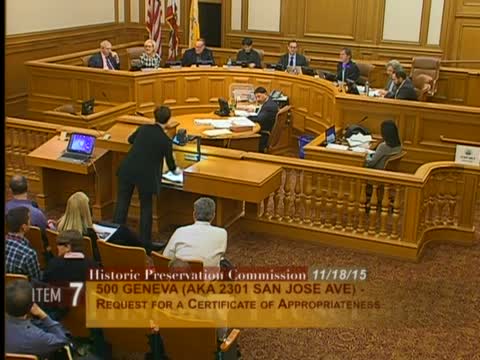
After extensive public comment, the Historic Preservation Commission approved a Certificate of Appropriateness for the Van Ness Bus Rapid Transit (BRT) project within the Civic Center Historic District, adopting staff conditions but amending the trolley‑pole requirement so the sponsor must return within six months with a separate C of A and rehabilitation plan for the historic poles.
The San Francisco Historic Preservation Commission on Nov. 18 approved a Certificate of Appropriateness for the Van Ness Bus Rapid Transit project within the Civic Center Landmark District, adopting staff‑recommended mitigation measures but amending the condition on historic trolley poles so that the project sponsor must return within six months with a separate rehabilitation plan.
Planning preservation staff had proposed five conditions intended to mitigate cultural‑resource impacts identified in the project’s Section 106 review: installing granite curbs where curb lines are modified within the district, removing the McAllister station shelter from the current proposal and requiring a separate C of A within six months, retaining and restoring four historic trolley poles with a maintenance plan, installing interpretive signage about the Civic Center district at McAllister station, and replacing poured‑concrete paving along the corridor so the sidewalks are consistent.
Peter Gaboncho, SFMTA project manager, told the commission and the public that funding rules tied to Federal Transit Administration (FTA) grants complicate adding granite where there previously was none, because FTA may deem such work a 'betterment' that is not eligible for core transit funds. "If the FTA comes back and says that, no, they consider it a betterment, then, we have to find a separate source of funding to pay for this work," Gaboncho said. He said the project team would pursue design adjustments and work with staff where platform granite is clearly transit‑related.
The hearing drew broad public participation focused largely on two themes: (1) preservation of historic features (notably the century‑old trolley/utility poles and historic lighting) and (2) protection of the Van Ness tree canopy and public access. Commenters included City Hall docents, neighborhood groups and preservation commissions. Jane Edwards, a City Hall docent, told commissioners, "I don't believe for a minute that these light poles cannot be repaired," arguing for rehabilitation rather than removal. Multiple speakers warned that moving the BRT to the median and removing mature median trees would harm the historic character and shade canopy of the Civic Center and would reduce accessibility for seniors and people with disabilities if stops are consolidated.
Commissioners acknowledged that many broader traffic and lane decisions are outside the HPC’s purview and focused instead on historic‑resource mitigation. During deliberations the commission refined condition #3: rather than requiring immediate retention and restoration of the four trolley poles as presented, it amended the condition to remove the historic trolley‑pole treatment from the current proposal and require the sponsor to seek a separate Certificate of Appropriateness within six months that includes a rehabilitation plan for those poles. The amended motion passed unanimously, 6–0.
What’s next: The sponsor will return with revised shelter designs and a separate C of A with a rehabilitation plan for the trolley poles within six months; staff will work with the sponsor on signage, granite curb proposals and sidewalk replacement as funding allows.