Get Full Government Meeting Transcripts, Videos, & Alerts Forever!
Get email alerts on the Facade Retention topic
No spam. Unsubscribe anytime.
San Francisco preservation commission opens study of facade retention, schedules workshop
Summary
The Historic Preservation Commission received a wide-ranging presentation on facade-retention approaches, heard public preservation advocates criticize superficial 'facadeism' (notably the Pine Street project), and agreed to pursue a staff/ARC workshop of local case studies before issuing firm guidance.
The San Francisco Historic Preservation Commission on Monday began a sustained inquiry into facade retention, hearing a presentation that laid out six types of approaches and drawing commissioners’ agreement to pursue a workshop and additional review rather than immediate policy change.
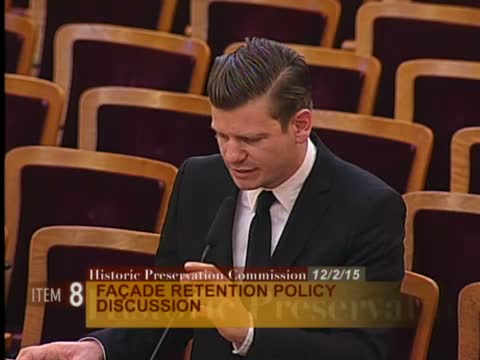
Justin Greving, a Planning Department preservation specialist, told the Commission that the review grew out of an earlier resolution asking for preservation alternatives and that facade retention had been left for fuller discussion. "This is an opportunity to start that dialogue about what facade retention means to the commissioners," Greving said, outlining examples ranging from standalone ornamental fragments to large-scale "hollowed-out core" projects where an exterior shell is retained and a new interior built.
The presentation grouped retention approaches into architectural folly, streetscape compilations, new mass behind old facades, corner-anchor strategies, base retention with large additions above, and hollowed-core reuse. Greving used local and national examples — including Pine Street, the Jesse Street power substation/Contemporary Jewish Museum conversion, and other projects — to show benefits (preserving material and street scale) and common drawbacks (loss of interior fabric, a disconnection between exterior and interior, or facades that feel meaningless without interpretive context).
Public commenters and preservation advocates urged the Commission to favor substantive preservation over superficial facade retention. Mike Buehler of San Francisco Heritage criticized the Pine Street outcome and suggested mitigation funds could better support higher-value preservation projects nearby. "To me it is also about allocation of resources," Buehler said, arguing that money used to prop up facades might be better spent protecting intact historic buildings.
Commissioners expressed divergent views. Several members, including Commissioner Hawes, warned against an "architectural petting zoo" of isolated facades; others said saving some exterior fabric is essential for long-term city character. Commissioners repeatedly described the issue as highly case-specific: "It's only good if it meets certain criteria," Commissioner Johns said, calling for analysis of what works in successful projects and why.
Staff and commissioners also discussed how CEQA and code thresholds interact with facade retention. Tim Frey (Planning Department staff) said whether demolition or retention triggers an EIR depends on the building's significance and how the project is characterized.
Rather than draft immediate citywide rules, the Commission agreed to pursue more work: staff suggested the Architectural Review Committee or a dedicated ARC workshop compile a portfolio of local projects for deeper evaluation and then return recommendations to the full Commission. Commissioners asked staff to include discussion of height/addition scale, examples of success and failure in San Francisco, and participation from staff who handled the original projects.
The Commission closed the hearing by directing staff to develop a workshop and follow-up materials; no binding policy or ordinance was adopted at the meeting. The next step is an ARC or workshop session to analyze about 10 projects and return findings to the Commission for further deliberation.