Get Full Government Meeting Transcripts, Videos, & Alerts Forever!
Get email alerts on the Affordable Housing Bonus Program topic
No spam. Unsubscribe anytime.
Planning staff previews Affordable Housing Bonus Program, projects up to 16,000 units possible
Summary
Planning Department staff presented the Affordable Housing Bonus Program (AHBP), proposing local incentives and limited height increases to produce more on-site affordable and middle-income housing; staff estimated up to 16,000 units citywide under the local program and scheduled a Planning Commission adoption hearing for Jan. 28.
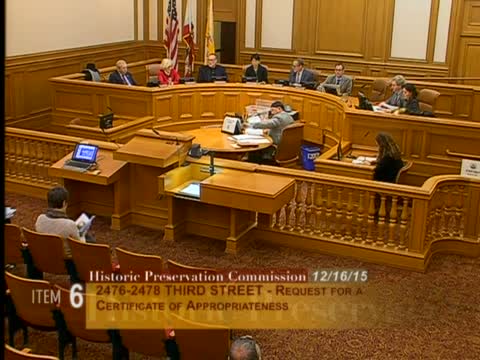
Planning Department staff presented an informational briefing on Dec. 16 on the Affordable Housing Bonus Program, designed to use state density bonus law and local incentives to encourage on-site affordable housing without public subsidy.
Monica Mohan, planning staff, told the Historic Preservation Commission the AHBP has four goals: incentivize more on-site affordable units, improve feasibility of underutilized sites, establish a middle-income program, and facilitate 100% affordable projects. She said the state density bonus law permits up to a 35 percent density increase and up to three zoning incentives; the local program adapts those limits to San Francisco’s context and adds a separate local track that would allow projects providing 30 percent on-site affordability to request up to two extra stories and three incentives from a menu crafted by staff.
Paolo Kizzoy, planning staff, outlined where the program would apply and the projected outcomes. He said the program area covers about 30,500 parcels (roughly 22 percent of city parcels) in zoning districts that regulate density by units-per-lot-area, chiefly neighborhood commercial districts and older multifamily neighborhoods. Under current zoning controls staff estimated those sites could yield about 7,400 new units in coming cycles, including roughly 900 affordable units if projects met existing inclusionary requirements. If all such sites pursued the maximum state bonus the city could see about 10,000 new units including approximately 1,500 affordable homes. Under the proposed local AHBP, staff estimated as many as 16,000 new units could be built over time, including about 2,000 homes for low and moderate income households and about 3,000 units affordable to middle-income households.
Staff emphasized design guidance and historic-resource protections. Mohan and Kizzoy said the local program includes design guidelines for taller buildings and nine specific guidelines for infill within potentially eligible historic districts; the state density bonus law also bars use of the bonus where it would demolish resources listed on the California Register. Staff said the program does not change demolition controls, design review, or the basic entitlement process for historic resources.
In public comment, Eileen Bokin warned that the program’s mapping of 30,000 sites could be misunderstood as identifying parcels for demolition. Staff and commissioners sought to clarify that the program area is broad by design and that staff projections assume new housing is more likely to be built on underdeveloped commercial sites, vacant lots, and surface parking lots rather than by widespread residential demolition. Staff also noted a Board of Supervisors amendment under consideration that would restrict demolition of buildings with rent-controlled units pending a year-long study.
Commissioners asked about community feedback on height bonuses, how the Commission’s review would be triggered for projects affecting historic resources, and how proposals for 100 percent affordable projects would be handled. Staff said they have done targeted outreach to neighborhood groups (including Districts 5 and Richmond neighborhood stakeholders and the Coalition for San Francisco Neighborhoods), worked with David Baker Architects on form and feasibility studies, and proposed administrative review paths for some 100 percent affordable projects while preserving public hearing opportunities and environmental review where required.
Staff said the Planning Commission adoption hearing is scheduled for Jan. 28 and that outreach to community groups and the Board of Supervisors process will continue in early 2016.
Ending: The presentation concluded with commissioners’ requests for further detail on triggers for historic-resource review, additional community outreach, and assurances that demolition of occupied rent-controlled housing would be studied prior to any policy that might facilitate such demolition.