Get Full Government Meeting Transcripts, Videos, & Alerts Forever!
Get email alerts on the Transportation Infrastructure topic
No spam. Unsubscribe anytime.
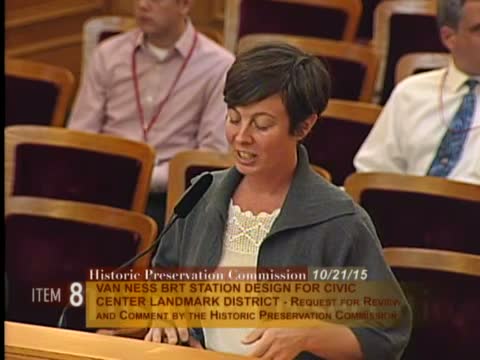
Historic Preservation Commission questions Van Ness BRT shelters, granite curbs and fate of century‑old trolley poles
Summary
Commissioners and staff debated design, materials and historic-asset treatment for the Van Ness Bus Rapid Transit project in the Civic Center landmark district, raising concerns about shelter form, platform granite curb use under FTA rules, and whether deteriorating historic trolley poles should be retained, relocated or salvaged.
The San Francisco Historic Preservation Commission on Oct. 21 reviewed design proposals for the Van Ness Avenue Bus Rapid Transit (BRT) project and gave detailed feedback on station shelters, platform materials and treatment of historic trolley poles that line the Civic Center landmark district.
Preservation staff framed the discussion around district contributing features — including 34 historic trolley poles, brick paving, granite curbs and early fire infrastructure — and recommended that platforms incorporate granite curbs where they match the district context and that a limited number of trolley poles be retained as artifacts with interpretive signage. Staff said the project should follow Secretary of the Interior guidance for Cultural Landscapes when possible.
SFMTA project manager Peter Gavancho described the BRT as a “complete streets” project rebuilding roadway, signals, sewers and nine transit stations. Project architects said Caltrans required horizontal pickets on station railings to preserve drivers’ sight lines, and platform geometry and a Caltrans-mandated reinforced curb limit options for granite at the platform back edge. Will Kwon, project architect, said available shelter footprints are small and constrained by an existing vendor contract; the design team proposed narrow canopies without ad panels and a frosted clear canopy as a color option.
Commissioners expressed repeated concern about the proposed “seismic wave” canopy and its industrial appearance around City Hall. Commissioner Hyland said the shelter and roof “is aghast” and urged the team to explore refinements. Several commissioners supported using granite curbs at the platform front where feasible to strengthen visual ties to the Civic Center’s granite buildings; staff and project team explained that some granite curb restoration may be limited by Federal Transit Administration funding rules because FTA funds must be tied to transit improvements.
A substantial strand of the hearing addressed the century‑old trolley poles. Some commissioners urged retaining and rehabilitating the poles and suggested using the Art Commission or Civic Center Business Improvement District to fund upkeep or to convert poles into public-art elements. The SFMTA project team cautioned that many poles are structurally unsound — citing spalling concrete and internal corrosion — and raised concerns about orphaned infrastructure and unclear long‑term maintenance responsibility if the poles are left in place.
Bob Macy of the San Francisco County Transportation Authority confirmed the project went through a full Section 106 environmental review and that the State Historic Preservation Officer (SHPO) provided concurrence during environmental clearance.
The Commission requested the project team return with refined shelter details and renderings, additional options for simplifying or refining off‑the‑shelf shelters (for example, hiding exposed bolts or finishing exposed elements), clarity on where granite curbs can feasibly be used given Caltrans and FTA constraints, and a plan for addressing historic trolley poles that balances preservation values and public-safety/maintenance realities. The item will return for a Certificate of Appropriateness hearing next month.