Get Full Government Meeting Transcripts, Videos, & Alerts Forever!
Get email alerts on the Civic Center Cli topic
No spam. Unsubscribe anytime.
Commission adopts Civic Center Cultural Landscape Inventory with staff corrections after experts flag errors
Summary
The commission adopted the Civic Center Cultural Landscape Inventory (period of significance 1896–1951) but asked staff to correct factual and typographical errors identified by public commenter Jim Haas before final publication.
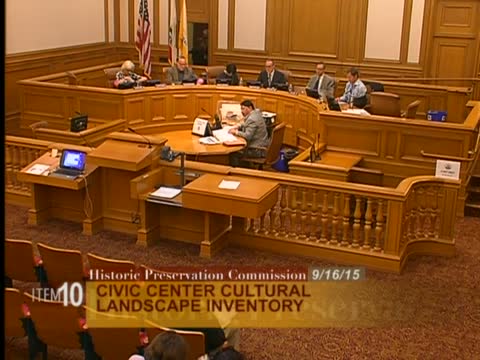
The Historic Preservation Commission voted unanimously on Sept. 16 to adopt the Civic Center Cultural Landscape Inventory (CLI), which documents landscape features across a 15‑block Civic Center area. Staff characterized the CLI as an inventory of landscape features — streetlights, monuments, granite curbs, plantings and public‑realm elements — that supplements architectural designations in the district.
Gretchen Hilliard (department staff) said the CLI finds the Civic Center cultural landscape significant under the National Register criteria for events and design, with a period of significance identified as 1896–1951. She also noted that UN Plaza and Civic Center Plaza required further evaluation tied to other city projects.
Public commenter Jim Haas, who submitted a detailed history and source notes to staff, identified what he described as multiple factual errors (misidentified mayors, bond amounts, architect attributions and other inaccuracies). Commissioners agreed that many of the errors were straightforward fixes staff could implement; they also stressed that the document was intended as a landscape inventory rather than a definitive comprehensive history.
Action taken: The commission voted to adopt the CLI findings while directing staff to perform factual corrections that can be handled administratively. The motion passed unanimously, 7–0. Staff indicated the consultant had been provided Mr. Haas’s materials and that additional substantial changes would be constrained by the consulting contract and project schedule.
What’s next: Staff will incorporate clerical and factual corrections identified at the hearing before final publication and will continue follow‑up on items requiring more in‑depth research.