Get Full Government Meeting Transcripts, Videos, & Alerts Forever!
Get email alerts on the Planning Downtown Plan topic
No spam. Unsubscribe anytime.
Planning staff summarize 2014 Downtown Plan monitoring: vacancies, hotel rates and development pipeline
Summary
City staff presented the five-year Downtown Plan monitoring report covering 2008'02/2014, highlighting a retail vacancy spike in 2009 now down to ~6%, average daily hotel rates up about 34% to roughly $254, and an office and housing pipeline including millions of square feet of planned office and thousands of housing units.
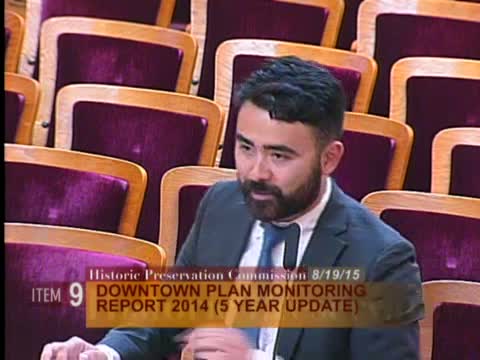
Paolo Quezoe of the Citywide Division summarized the 2014 Downtown Plan monitoring report for the Historic Preservation Commission Aug. 19, noting key economic and development indicators spanning 2008 to February 2014.
Quezoe said commercial vacancy rates rose in 2008 and peaked through 2010 before falling; retail vacancy downtown spiked to nearly 11% in 2009 and was back to about 6% by the report's end. He noted that average daily hotel room rates had ‘‘risen almost 34% since 2008 and are now at about $254 per night." The Downtown Plan and its implementing Proposition M limit approvable citywide office space to 950,000 square feet annually; from 2008 to 02/2014, 6,140,000 square feet was allocated, leaving roughly 3,000,000 square feet of surplus at the report's end. About 1,600,000 square feet of net new commercial space was constructed in the downtown C-3 districts during that period.
Quezoe also highlighted housing production: 14,400 housing units delivered citywide over the report period, with roughly 30% located in downtown C-3 or downtown residential districts. Looking ahead, he reported roughly 3,600,000 square feet of office development in the downtown pipeline and almost 5,400 units of housing in that pipeline, with a larger citywide residential pipeline of about 50,500 units.
Commissioners asked how monitoring categories were chosen and whether additional indicators tied to urban form and open space could be added. Quezoe said the monitoring requirement stems from administrative code tied to the Downtown Plan and that staff would consider additional measures for future reports.
The presentation concluded without action; staff offered to return with further information as requested by commissioners.