Get Full Government Meeting Transcripts, Videos, & Alerts Forever!
Get email alerts on the Preservation Policy topic
No spam. Unsubscribe anytime.
Historic Preservation Commission adopts Preservation Alternatives Policy after clarifying facade-retention language
Summary
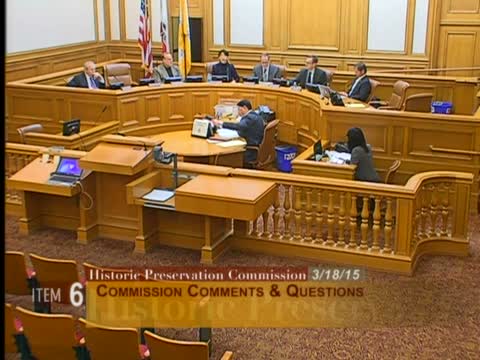
The San Francisco Historic Preservation Commission on March 18, 2015, adopted a Preservation Alternatives Policy (unanimous 6–0) after revising language about treating 'resources' broadly and clarifying when facade retention may be an appropriate partial preservation alternative.
The San Francisco Historic Preservation Commission voted unanimously on March 18 to adopt a Preservation Alternatives Policy that broadens references from "structures" to "historic resources" and clarifies how facade retention figures into CEQA review.
Tim Frey of the Department staff presented a revised "clean" draft and said the only substantive change was rewording in the second paragraph of the Preservation Alternatives section, which the City Attorney helped refine. He told commissioners the updated copy was available to the public and that the Planning Commission had expressed interest in the resolution.
Lisa Gibson, senior planner with the Planning Department, outlined the edits. She said language was changed in several places from "structure" or "building" to the broader term "resource," and the draft now states that alternatives considered under CEQA do not need to meet all project objectives. Gibson read the revised paragraph on partial preservation options, saying that in many cases retaining only a historic facade "may not eliminate or sufficiently reduce a significant impact for CEQA purposes" and that facade retention alone generally is not an appropriate partial preservation alternative, though it may be useful in combination with other features on a case-by-case basis.
Commissioners pressed staff on whether the language adequately covers cultural landscapes as well as built structures. Several commissioners recommended phrasing such as "historic features, such as facade retention," or referencing "features of the resource" so the guidance would apply more broadly than to buildings only. Gibson said the first paragraph in the policy was intended to be generic and include landscapes, while the second paragraph was intended specifically for cases where the resource evaluated in an EIR is a structure.
Desiree Smith of San Francisco Heritage spoke in support of the revisions, saying her organization had submitted comments at the previous hearing and that the latest version addressed their recommendations. "We feel this policy will be very important and useful moving forward," Smith said.
After an initial vote that was later retracted to allow staff and commissioners to confirm wording, the Commission reopened the item, clarified the intended scope, and voted to adopt the Preservation Alternatives Policy as revised. The final vote was unanimous 6–0.
Frey said staff will continue to coordinate with the Planning Commission and may return with further design-focused discussion on facade retention at a future meeting. The department also plans outreach and distribution of the final policy to interested parties.
The adopted policy emphasizes case-by-case consideration of partial preservation measures in CEQA analyses, broadens the term "resource" to capture cultural landscapes, and directs clearer, more detailed descriptions of preservation alternatives in draft EIRs.