Get Full Government Meeting Transcripts, Videos, & Alerts Forever!
Get email alerts on the Planning Policy topic
No spam. Unsubscribe anytime.
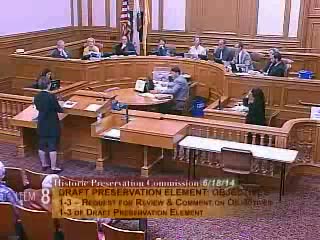
Staff lays out revisions to preservation element objectives 1–3; commission requests clearer policies and definitions
Summary
Planning staff presented draft revisions to the preservation element’s first three objectives, proposing to reframe objectives, move action-level items into implementation measures, and expand coverage of intangible, social heritage and archaeological resources. Commissioners and public urged clearer definitions (e.g., 'recent', 'underrepresented'), stronger language on city-owned resources and significant interiors, and a timeline for public outreach.
Department staff presented proposed revisions to Objectives 1–3 of the draft Preservation Element and sought commissioner direction on structure, definitions and priorities.
Shelly (department staff) told the commission that the 2007 draft needs updates to reflect new preservation legislation and best practices. Staff suggested rewriting Objective 1 (identify and inventory historic resources) to emphasize both tangible and intangible cultural resources and social heritage themes; they recommended moving detailed actions — such as commissioning a citywide survey, developing a city register, and building an archaeological GIS — into implementation measures to keep policies concise and strategic.
Commissioners debated terminology and emphasis. Several asked to replace the words “tangible/intangible” with clearer terms such as “architectural, historical, cultural and archaeological,” and to define “recent” for resources of the recent past. Commissioners also discussed whether city-owned historic resources should be singled out so the city can “lead by example.” Public commenters from preservation groups pressed for retaining policy language supporting identification of historic districts and for stronger protections for significant interiors.
On Objective 2 (protect and preserve), staff recommended focusing on concrete management tools — designation, restoration, rehabilitation and adaptive reuse — rather than the broader wording “protect.” Commissioners split on whether to retain a short, strong objective statement (e.g., “protect and preserve historic resources”) or adopt staff’s phrasing emphasizing integration of historic considerations into planning and permitting.
On Objective 3 (archaeological resources) staff suggested keeping archaeology as a distinct objective to enable tailored policies, while moving technical items (e.g., GIS) into implementation measures and adding educational and interpretive requirements. Commissioners generally supported a separate archaeological section given differences in how these resources are discovered and handled in projects.
Staff outlined next steps: two more hearings (July for Objectives 4–6, August for 7–9), a public open house on Sept. 10, stakeholder outreach in fall/winter, and a plan to revise text for CEQA and eventual adoption. Commissioners requested staff return with consolidated rewritten text (not just line-by-line comments) and with the preservation element coordinated with other ongoing work such as the local interpretation of Secretary of the Interior standards.