Get Full Government Meeting Transcripts, Videos, & Alerts Forever!
Get email alerts on the Historic Preservation topic
No spam. Unsubscribe anytime.
Historic preservation commission backs planning-code changes to limit office conversions in PDR landmark buildings
Summary
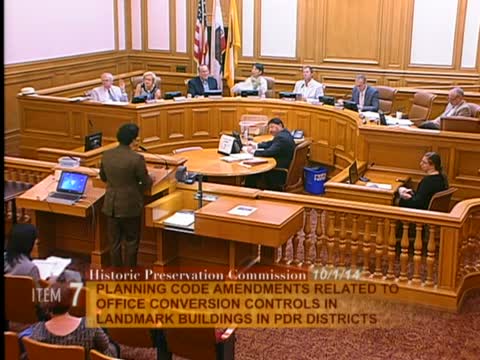
The San Francisco Historic Preservation Commission on Oct. 1 recommended that the Planning Commission require conditional-use review and a historic structures report for proposed office conversions in landmarked buildings in PDR districts, clarifying the HPC’s and Planning Commission’s distinct roles.
The San Francisco Historic Preservation Commission voted unanimously Oct. 1 to recommend changes to the Planning Code that would require conditional-use review by the Planning Commission and a historic-structures report before permitting office conversions in landmarked buildings located in PDR (production, distribution, repair) districts. The Commission also clarified its own role in reviewing historic-structures documentation.
Andrea Bruss of Supervisor Cohen’s office told the Commission staff had incorporated feedback from the HPC and community stakeholders, and that the updated draft would “require the use or the approval of a historic structures report” and give the Planning Commission the authority to consider tenant relocation and economic-impact analyses as part of conditional-use determinations. Tim Frey, department staff, said the revised resolution expands Section 219.2 and structures the Commission’s recommendation as a resolution for the Planning Commission and Board of Supervisors.
Commissioners discussed how the proposed changes separate landmark designation from change-of-use review so that a property could be landmarked without automatically permitting a change to office use. Commissioners asked how tenancy and monitoring would work in practice, and staff explained that zoning regulates permitted uses rather than specific tenants: if a conditional-use allows office space, future tenancy generally is not monitored, though staff noted the economic realities that tend to make office uses permanent.
Several commissioners suggested measures to retain PDR history in landmarked buildings, including interpretive displays and signage, and staff said such interpretive elements could be considered through the landmarking process. Commissioner Johns moved adoption of the Commission’s recommendation; the motion carried unanimously, with the Commission voting to forward the recommended modifications to the Planning Commission and Board of Supervisors for consideration.
Next steps: staff will forward the HPC’s resolution and the revised language to the Planning Commission and work with the city attorney’s office as the item advances through committee and the full Board of Supervisors.