Get Full Government Meeting Transcripts, Videos, & Alerts Forever!
Get email alerts on the Public Art Light Installation topic
No spam. Unsubscribe anytime.
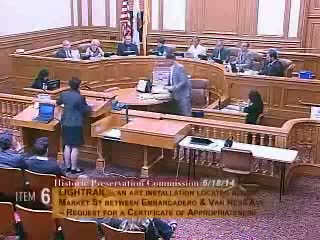
Historic commission approves Market Street light-rail art installation with no pole-mounted boxes
Summary
The San Francisco Historic Preservation Commission approved a temporary LED “light rail” installation on Market Street with conditions: no boxes mounted to Path of Gold poles, a single 3/4-inch hole drilled near the catenary for wiring, and a two-year check-in. Staff and sponsors will finalize design, maintenance and repair plans before permits.
The San Francisco Historic Preservation Commission on June 18 approved a Certificate of Appropriateness for a temporary, privately funded LED installation that will span about 2.1 miles of Market Street, provided the project meet several conditions the commission added.
The commission voted 7–0 to remove references to and prohibit “boxes” mounted to the Path of Gold light standards and to allow only a single three-quarter-inch hole near each fixture’s catenary to carry wiring. Commissioners said the changes respond to concerns that equipment mounted on the distinctive vintage poles would harm the visual character of the Path of Gold.
“Staff should eliminate any reference to utility boxes,” Commissioner Wolfram said before moving the motion. Staff earlier recommended approval with conditions, including a two-year approval period, a maintenance and removal plan and a requirement that the project return for a new certificate after two years.
Project sponsors said they had altered the design after feedback from the Architectural Review Committee and preservation staff. “We took the equipment from those eight to 10 poles and proposed to put it in a larger box fastened onto the outside of that cabinet,” said Brady Nadel, senior project manager for Parsons Brinckerhoff, describing an approach that would locate most equipment in 23 existing street cabinets rather than on individual poles. Nadel said the installation would still require small holes in poles to route wiring but that the revised approach would avoid most pole-mounted enclosures.
Allison Van der Sluis, preservation staff, told commissioners that the project team had supplied repair details and a draft maintenance and removal plan and that additional design details should be finalized with staff prior to permit issuance. Staff also recommended that wiring visible on the poles match pole color, and that the project return after two years for review because a four-year installation would begin to feel permanent.
Deputy city attorney Marlena Burn (Byrne) advised that the commission may approve the project with revised findings and conditions if the changes and how they affect the decision are outlined at the hearing, avoiding the need for a separate motion of intent or a new hearing.
The approval requires the project sponsor to submit final utility box design details (if any), a final path-of-gold maintenance and removal plan, MTA input regarding repairs to the pole finish, and an explicit plan for restoring any drilled holes and pole surfaces.
The commission’s decision does not approve permanent modifications to the poles; staff will return the case for future review if the sponsors seek extensions or changes beyond the temporary period.