Get Full Government Meeting Transcripts, Videos, & Alerts Forever!
Get email alerts on the Preservation Element topic
No spam. Unsubscribe anytime.
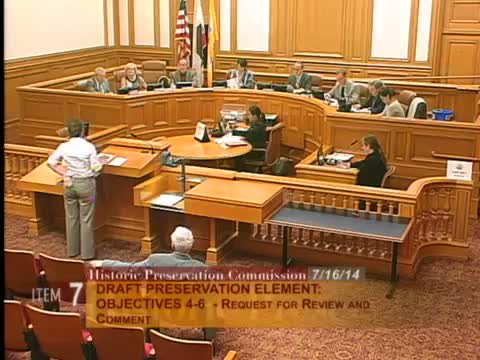
Historic Preservation Commission debates stronger preservation standards, ADA guidance and incentives in draft element
Summary
The San Francisco Historic Preservation Commission reviewed draft preservation element objectives 4–6 July 16, weighing stronger language on managing change, use of Secretary of the Interior Standards, ADA and life-safety guidance, and proposals for process- and zoning-based incentives; staff plans public outreach starting in September and a full draft later in 2014.
San Francisco’s Historic Preservation Commission on July 16 reviewed draft preservation element objectives 4 through 6 and pressed staff for clearer, stronger language to guide future land-use decisions and incentives.
Shelly Caltagironi, preservation staff, told commissioners that Objective 4 would continue to require that changes to the built environment "respect the historical character and heritage of the city," and staff recommends applying the Secretary of the Interior Standards as a framework for local design guidelines and adding guidance to accommodate Americans with Disabilities Act and life-safety improvements in a way that "respects the historic character of the resource." She also proposed that the document spell out implementation measures and interagency guidance so the Planning Department can coordinate with other city agencies.
Commissioners pushed for firmer wording. "The word ‘respect’ is okay, but doesn't really carry my sense of passion and strength," Commissioner Jeong said, urging language that would ‘‘support, provide access to, enable appreciation for’’ historic resources. Several commissioners warned against wording that would turn the Secretary of the Interior Standards into an absolute requirement; Commissioner Johns said the standards are best described as guidance and favored language like "consistent with" or "compatible with" rather than "comply."
The Commission also discussed Objective 5, which staff proposes to rephrase so that during the planning process the city would "identify any potential adverse impacts to historic and cultural resources and implement measures or alternatives to reduce or avoid those impacts, including achieving conformance with the standards." Commissioners suggested tightening the sentence (for example, replacing "including" with "achieve") and debated whether redundant-sounding policies should remain for emphasis.
Under Objective 6, staff proposed three new policies: promote process-based incentives (priority processing, fee reductions), create zoning-based incentives or bonuses for historic resources, and provide technical support to connect property owners with state and federal incentive programs. "If you list incentives, include concrete examples so people understand what you mean," Commissioner Johns said; others cautioned that priority processing can be overused if not clearly defined.
Public commenters urged the Commission to expand the element’s scope beyond architecture. "We strongly support staff recommendations to expand the scope to apply to all eligible historic resources," Mike Buehler of San Francisco Heritage said, and urged the inclusion of social-heritage resources and a post-earthquake evaluation procedure for historic resources. Richard Zelman and Jim Marshall (Victorian Alliance) urged more emphasis on restoration and better incentives for small-property owners to undertake rehabilitations.
Staff said the draft preservation element will include implementation measures and that the Planning Department will begin public outreach in early September, with a full review expected by late 2014. Commissioners asked staff to return with clarified implementation steps, specific incentive examples (including whether zoning tools such as transferable development rights would be considered), and clearer wording on how the Secretary standards will be applied and interpreted locally.
The Commission will continue review of the preservation element at future hearings; staff said objectives 7 through 9 are scheduled for the next meeting on August 20.