Get Full Government Meeting Transcripts, Videos, & Alerts Forever!
Get email alerts on the Landmark Designation topic
No spam. Unsubscribe anytime.
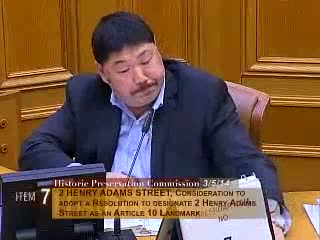
Commission forwards landmark recommendation for 2 Henry Adams Street, adds public‑access display requirement
Summary
The Historic Preservation Commission voted March 5, 2014, to recommend Article 10 landmark designation for 2 Henry Adams Street (Dunham, Kerrigan and Hayden Building) to the Board of Supervisors, amending the recommendation to require a publicly accessible interpretive display and to change 'appears to meet' to 'meets' in the resolution.
The San Francisco Historic Preservation Commission voted unanimously on March 5, 2014, to forward a recommendation for Article 10 landmark designation of 2 Henry Adams Street — historically known as the Dunham, Kerrigan and Hayden Building — to the Board of Supervisors with two amendments: change language in the resolution from "appears to meet" to "meets" eligibility requirements, and require a publicly accessible interpretive display to be included in the ordinance language.
Susan Parks, department staff, told commissioners the city attorney had prepared a draft designating ordinance and that the department supports the recommendation. "The ordinance requires that the owners adhere to a sign program which will be subject to a certificate of appropriateness at a future date," Parks said. She also noted that the owners filed for an office allocation for the property; that allocation will be considered at a future planning commission hearing.
Project sponsors and owners emphasized a staged transition and a commitment to retain ground‑floor showroom uses. Sean Murphy of Bay West Development said the sponsor intends to keep the Galleria and showroom character at street level while allowing a gradual conversion of upper floors over time, and he stressed that tenant relocations "would be borne by us. They would never be borne by the tenants." Murphy noted existing tenant leases that extend through 2017 and 2022.
Several public commenters, including Rafad Shaheen and David Dixon, warned that landmarking combined with an office allocation could be used to convert showroom PDR (production, distribution, repair) space to office, displace long‑standing businesses and raise rents. Shaheen said the landlord "intends to circumvent the restrictions of PDRUs and begins the initial phase of converting more than a quarter million square feet of showroom space into office space," and urged an oversight process. David Dixon, a showroom tenant for nearly 30 years, said he would have limited relocation options and that his business (which he stated as about $10,000,000 in annual revenue) could be jeopardized.
Staff and commissioners discussed broader PDR policy for Eastern Neighborhoods and noted that rezoning had shifted the city toward parking maximums rather than new on‑site parking minimums. Tim Fry, department staff, said the office allocation incentive was created through the Eastern Neighborhoods rezoning to help adaptively reuse historic buildings and that Article 10 provides protections beyond survey identification.
Commissioner Jeong moved to adopt the recommendation with the amendments requiring a publicly accessible interpretive display and changing the phrasing to "meets" the eligibility requirements. The commission approved the motion unanimously, 6 to 0. The department will forward the amended recommendation and draft ordinance language to the Board of Supervisors, and the office allocation will proceed separately at the planning commission in a future hearing.