Get Full Government Meeting Transcripts, Videos, & Alerts Forever!
Get email alerts on the Pitt Count topic
No spam. Unsubscribe anytime.
HSH: San Francisco's 2024 PIT count shows modest rise in total homelessness, sharp increase in vehicle homelessness
Summary
HSH officials reported a 7% rise in total homelessness since 2022, with more families sheltered and a 37% increase in people living in vehicles; HSH released new dashboards and said limitations remain in a single-night count.
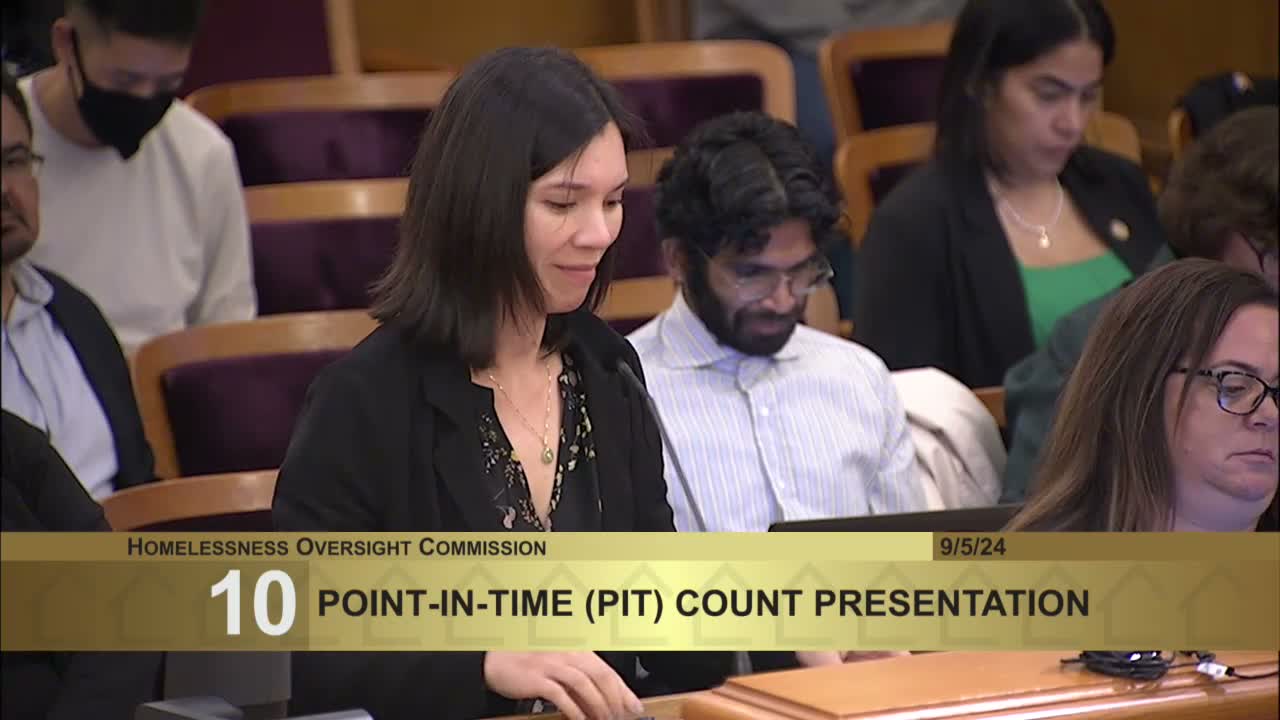
Shereen McSpadden, director of the San Francisco Department of Homelessness and Supportive Housing (HSH), and Sarah Loker, HSH manager of data and performance, presented the city's 2024 point-in-time (PIT) count and related data to the Homeless Oversight Commission. HSH reported a 7% increase in total homelessness since 2022 and described shifting patterns in where and how people are living.
The PIT counted 4,354 people living unsheltered on the night of the survey and 3,969 people in shelter or transitional housing. Loker said unsheltered street and tent counts were down 13% from 2022, while the number of people identified as living in vehicles rose 37% from 2022. "We observed more people in vehicles and fewer visible street encampments," Loker said during the presentation.
HSH attributed part of the trend to improved methodology for counting vehicular homelessness, including a sunrise vehicle count and targeted outreach partnerships with Compass Family Services and Catholic Charities. The department also released interactive dashboards intended to let stakeholders explore demographic and geographic breakdowns.
Key subpopulation trends included an 11% increase in the count of people identified as chronically homeless, a 53% increase in sheltered families since 2022, and a smaller overall youth population than in earlier years but with improved sheltering levels for youth. Loker noted racial disparities in the PIT data, with Black and Latine residents overrepresented among people experiencing homelessness compared with their share of the city's general population.
HSH emphasized the PIT is a single-night snapshot and has limitations: some living situations (for example, people doubled up, in motels or institutional settings) are not captured. Loker noted HSH had housed more than 7,500 clients between the 2022 and 2024 counts but estimated that inflow into homelessness remains high. "Despite the progress of housing placements," she said, "we estimate roughly three people become newly homeless for every one person housed."
Commissioners and public commenters used the discussion to press for more data disaggregation, clarity about vacancy and unit-offline definitions, and follow-up reporting on case management ratios. HSH said it would publish more property-level vacancy and offline-unit data and invited the commission to review interactive dashboards and the full PIT report posted on its website.
Provenance: topicintro SEG 3190, topfinish SEG 3553.