Get Full Government Meeting Transcripts, Videos, & Alerts Forever!
Get email alerts on the Land Use Rezoning topic
No spam. Unsubscribe anytime.
Gastonia council continues public hearing on 650‑unit Tucker Spring Haven rezoning after traffic and access concerns
Summary
The Gastonia City Council continued a public hearing on a developer request to rezone roughly 262.84 acres for up to 650 homes after extended questions over traffic access, timing of a required Traffic Impact Analysis (TIA) and incomplete connectivity guarantees. The hearing was continued to Jan. 18, 2025.
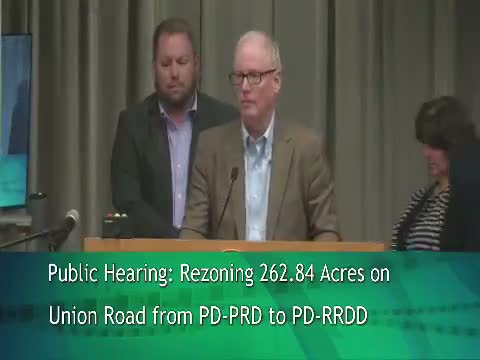
Gastonia City Council on Nov. 19 reopened a public hearing on a rezoning application for approximately 262.84 acres located along Union/Union New Hope Road, then voted to continue the hearing to Jan. 18, 2025 after extensive questions about traffic, access and infrastructure.
The applicant, represented by John Carmichael and consultants for David Weekley/Weekly Homes, proposed rezoning the site to a PDR2D2/R2D2 district to permit up to 650 dwelling units: as submitted a maximum of 200 townhomes, 300 non‑age restricted single‑family detached homes and 150 age‑restricted (55+) single‑family homes. The site plan includes two amenity centers, pocket parks, a portion of the Carolina Thread Trail and roughly 86 acres of open space (about 24% of the site), with stormwater control measures and preservation of flood‑plain and stream buffers.
Planning staff told council the proposal is consistent with the city—s future land‑use map and that the item had resulted in a 3–3 split at the Oct. 3 planning commission meeting. Staff and the applicant confirmed a Traffic Impact Analysis (TIA) would be required as a condition of approval and would identify mitigations the developer must build and fund. Council members repeatedly pressed whether the TIA should be completed before a rezoning decision and whether one primary access off Union New Hope Road is appropriate for a project of this scale.
Council members and the public raised several recurring concerns: the potential for a long "funnel" of traffic into a single primary access; uncertainty about whether adjacent parcels (identified on the zoning map as possible future access points) would be acquired to widen ingress/egress; the timing of a broader corridor study; and how traffic generated by multiple nearby developments would be coordinated. Meg Mason Chapman, speaking for the Planning and Zoning Commission, urged that commissioners in favor believed the TIA would address many issues but acknowledged the commission split reflected unresolved questions.
A resident, Dan Soudares, urged the council to weigh impacts on existing rural neighborhoods and the rise of multiple nearby developments. Developers stressed a phased build‑out spanning several years (sales from about 2027 through the early 2030s) and noted conditions limiting construction without required connections (the applicant stated a condition limiting construction beyond 100 lots before secondary connections).
After discussion and procedural maneuvering, council rescinded an earlier vote to close the hearing and then approved a 60‑day continuance to Jan. 18, 2025 so the applicant can respond to questions and staff can pursue additional information, including the joint TIA approach staff is exploring for multiple area projects. The public record remains open; the applicant will return to respond to council questions and any updated studies or commitments.
Next steps: the applicant will coordinate with city staff on the timing and scope of the required TIA and any conditions; council will revisit the rezoning at the Jan. 18, 2025 meeting.