Get Full Government Meeting Transcripts, Videos, & Alerts Forever!
Get email alerts on the Homelessness topic
No spam. Unsubscribe anytime.
Gaston-Lincoln-Cleveland Continuum of Care updates council on rising homelessness, local responses
Summary
Consultant Carson Dean told the Gastonia City Council the CoC's Jan. 2024 point-in-time count recorded 451 people across three counties, and he urged capacity-building to compete for HUD funds; council pressed for clearer outreach contacts and immediate warming-shelter coordination.
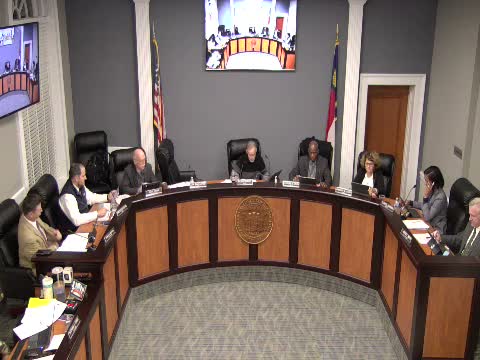
Consultant Carson Dean briefed the Gastonia City Council on Dec. 3 on the Gaston-Lincoln-Cleveland Continuum of Care's (CoC) strategic work and local homelessness trends, saying the national picture has worsened and that local coordination must accelerate to meet rising need.
"Last year in 2023 there were a record 650,000 people, men, women and children experiencing homelessness across our country," Dean said, noting that the CoC's Jan. 2024 point-in-time count recorded 451 people across the three-county region and 153 unsheltered people in Gaston County. He cautioned the PIT is a one-night snapshot and typically undercounts ongoing need.
The CoC coordinates applications for two main federal funding streams: the state-administered Emergency Solutions Grant (ESG) and HUD's national Continuum of Care grant. Dean said the CoC captured 100% of available ESG funding this cycle, yielding $185,000 to flow into the community in January, and that the collaborative applied competitively for roughly $1.5 million in HUD CoC funding this year.
Dean described the CoC's strategic plan, adopted in late 2022, and four overarching goals including infrastructure, capacity building and improved performance measurement. He emphasized the need for multi-year preparation for permanent supportive housing projects, saying such developments can take years to stand up and require early planning to be competitive for HUD awards.
Council members pressed for immediate operational details. Councilwoman Barber asked how the CoC is involved in current warming-shelter operations amid cold weather; Dean said while the CoC as a coordinating entity does not run every shelter, member agencies and faith-based partners operate warming sites and the CoC provides technical assistance. He named a local outreach worker, Asia, as a boots-on-the-ground contact and said staff would provide that contact information to the council.
Several council members expressed frustration that long-term coordination has not produced visible reductions in street homelessness. One councilor criticized the "30-year track record" of agencies and said taxpayers had funded a recently opened warming shelter. Dean and other presenters responded that federal funding rules limit how grant dollars may be used (restricting some administrative or standalone weatherization uses), that agencies receive grants directly from HUD or the state, and that the CoC largely serves as a collaborative applicant and coordinator to bring resources into the region.
Dean also highlighted CoC initiatives: a new bonus project for domestic-violence services that would add roughly $200,000 to the region; increased CRC planning dollars (about $20,000 more this year) to support strategic implementation; expanded street outreach and a mobile outreach unit; and an emphasis on Housing First principles, where housing is offered without preconditions and services remain voluntary.
On performance outcomes, Dean said roughly 465 people were engaged in CoC-funded programs during the reporting period; of program participants who engaged for the six months leading up to Oct. 1, he reported a substantial share did not return to homelessness, and he urged accelerating front-end engagement and improving bed utilization to prioritize permanent supportive housing.
The CoC said it will return to council with additional implementation details as strategies specific to veterans and other prioritized populations are refined and as staff can present disaggregated data by county. The council and staff also discussed volunteer recruitment for the upcoming Jan. 30, 2025 point-in-time count.